
 Posts
Posts


I've probably seen as many first-run 2017 releases as I'm going to. So here are my favorite films that played at least one week in Manhattan for the first time in 2017, in approximate order of preference:
1. Staying Vertical (Alain Guiraudie, France)
2. The Unknown Girl (Luc and Jean-Pierre Dardenne, Belgium)
3. Mister Universo (Tizza Covi and Rainer Frimmel, Italy/Austria)
4. How Heavy This Hammer (Kazik Radwanski, Canada)
5. Downsizing (Alexander Payne, USA)
6. I Hate Myself :) (Joanna Arnow, USA)
7. Hermia & Helena (Matias Pineiro, Argentina/USA)
8. The Wedding Plan (Rama Burshtein, Israel)
9. Marjorie Prime (Michael Almereyda, USA)
10. Ma Loute (Slack Bay) (Bruno Dumont, France)
11. La Patota (Paulina) (Santiago Mitre, Argentina)
12. A Ghost Story (David Lowery, USA)
A few good films that received their first NYC theatrical run this year felt too old to put on a 2017 list: Yang's Taipei Story, Hou's Daughter of the Nile.
Lately I wonder why I even make this list. I keep a perfectly good list of favorite films by international release date. What gets released in the US in a given year is in the lap of the gods. Theoretically one makes such a list because those are the films one's readers are likely to have seen. But that's no longer the case, if it ever was: many of the films on my list were exhibited in such a DIY fashion that they were barely more accessible than a one-day booking. (Those DIY bookings are awesome, by the way, don't get me wrong.) I'll probably keep these lists coming, just out of habit - but if you don't see one next year, you'll know why.
Thursday, January 18, 2018
Saturday, June 10, 2017
Lubitsch's Angel, 1978
I wrote this paper on Ernst Lubitsch's 1937 Angel when I was 22 years old, for a 1978 Steve Mamber class at UCLA. As usual with my early film writing, I'm embarrassed by the paper's youthful arrogance and excessive zeal for categorization. But the current Lubitsch retrospective at Film Forum prompted some friends to ask me for writing on Angel (one of my very favorite films), and I'll never have the chance to go into this much detail again. Below are scans of the original paper, with some of Steve's sensible criticisms still visible. I took the liberty of omitting a useless introductory paragraph.





Wednesday, February 8, 2017
James Bridges
In a comment on my last post, dm494 asked for a blurb on James Bridges' Mike's Murder that I wrote in 1984 for the Los Angeles Reader. I don't think much of the blurb, but here it is, along with a second blurb on Bridges' 1985 Perfect.


Thursday, January 26, 2017
2016 Manhattan One-Week-Run Premieres
Here are my favorite films that played at least one week in Manhattan for the
first time in 2016, in approximate order of preference:
- L'avenir (Things to Come) (Mia Hansen-Løve, France)
- Manchester by the Sea (Kenneth Lonergan, USA)
- The Apostate (Federico Veiroj, Uruguay/Spain)
- Fireworks Wednesday (Asghar Farhadi, Iran)
- Trois souvenirs de ma jeunesse (My Golden Days) (Arnaud Desplechin, France)
- For the Plasma (Bingham Bryant and Kyle Molzan, USA)
- Francofonia (Aleksandr Sokurov, France)
- Mia Madre (Nanni Moretti, Italy)
- Short Stay (Ted Fendt, USA)
- A Hologram for the King (Tom Tykwer, USA/Germany)
- Right Now, Wrong Then (Hong Sang-soo, South Korea)
- The Fits (Anna Rose Holmer, USA)
- Fatima (Philippe Faucon, France)
Friday, December 16, 2016
Rabah Ameur-Zaïmeche and The Story of Judas
I was asked by programmer Delphine Selles-Alvarez to introduce FIAF's December 13 screening of the 2015 film Histoire de Judas (Story of Judas), the last film in a complete Rabah Ameur-Zaïmeche retrospective. There isn't much written on Ameur-Zaïmeche in English, and my notes for the introduction read well enough, so:
=====================================
I’d like to discuss some of the qualities of Ameur-Zaïmeche’s work so far, and talk a little about how tonight’s film grows out of what Ameur-Zaïmeche did before.
Some characteristics that we find in his work from the beginning:
1. An attention to documenting places and evoking their ambience, with emphasis on natural sound and a pleasure in long shots and long takes. He has a good compositional sense, with an eye for natural grandeur.
2. A tendency to suggest story rather than foreground it, giving a few muted story cues along with his evocations of locations: story emerges from within the ambience, or hides within it.
3. A tendency to present sympathetic and unsympathetic actions in a similar manner, and to let signals about characters be absorbed in the prevailing mood of the environments he creates.
The last three elements taken together make one think of Jean Renoir, in that both filmmakers want to document the world and in some sense they don’t want the fiction to triumph over the documentary - they want the fiction to be infused with the qualities of the documentation. As a side effect, both filmmakers evince a generosity toward people.
A few of Ameur-Zaïmeche’s characteristics come on stronger with his third and fourth films, Adhen and Les chants de Mandrin (Smugglers' Songs):
1. A romanticism in the presentation of people and their struggles, and a pleasure in the heroic. The romanticism also has the general effect of making characters more admirable - Histoire de Judas is a good example.
2. A taste for abstraction in his stories and subjects: a suggestion of allegory or symbolism, a preference for stories that point to larger issues. This tendency collides in an interesting way with the realism of image and sound that Ameur-Zaïmeche likes. The ambient style and the romantic largeness of the gestures and stories modify each other. One can almost define Ameur-Zaïmeche’s style as the combination of these two tendencies.
Adhen used an unusual setting and striking art direction to create a sense of microcosm, of a part representing the whole. And after that Ameur-Zaïmeche left modern times and took up legendary subjects. The socialist politics in his films come to the surface in this period, but the politics are expressed in romantic, heroic terms - I feel as if the romanticism is at least as important to him as his political aims.
On Histoire de Judas:
The solemnity of this particular story seems as if it might weigh the film down, but Ameur-Zaïmeche soon starts doing peculiar things with the material - the sanctified subject matter throws Ameur-Zaïmeche’s daring into relief. One small sign of his assertion is the modern way Jesus and Judas express their mutual affection: he humanizes them by transforming them into bros. I kind of like it because it’s so much him, even if it’s not the way I might approach the material: he’s using that male energy that we see in his other films.I don’t want to give away the plot, but you’ll see big deviations from the New Testament version as the story goes along, changes that feel more artistically than politically motivated. One interesting addition that can perhaps be mentioned without spoiling the film is the important character of the madman who impersonates Jesus and functions in the film as his double, and who eventually is the focus of a emotional scene on the site of the crucifixion. Though such additions to the story are a bold gesture, they don’t alter the intent of the original much: Ameur-Zaïmeche seems to be trying to make vivid to himself the emotions of the story, rather than depart from it in fundamental ways.
In his last three films, Ameur-Zaïmeche has been moving a step at a time toward legend and grandeur: from the abstract conflict of Adhen to the Robin Hood-like figures of Les chants de Mandrin to the Christ story. I’m curious where he goes from here, as his stories have pretty much gotten as big as they can get.
Monday, October 17, 2016
Don Siegel, 1980
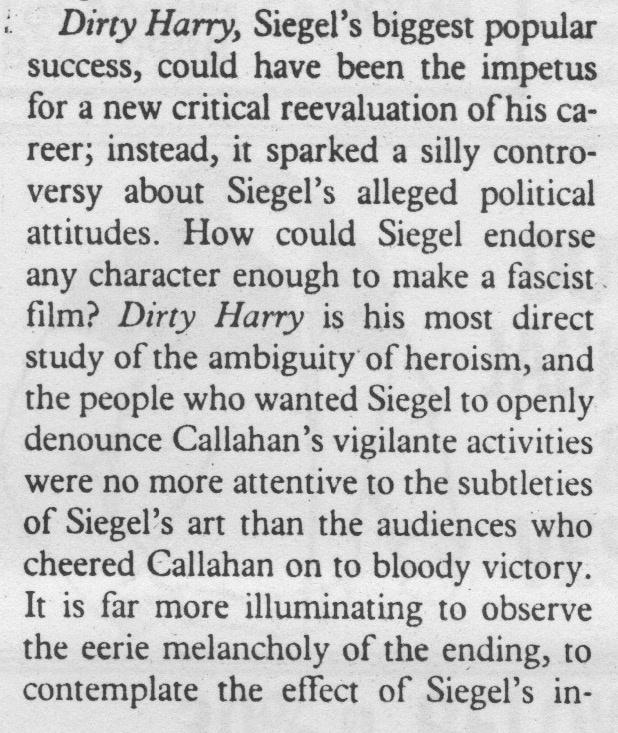
I'm experimenting, none too successfully, with using Blogger to post .jpgs of print articles. This piece appeared in the L.A. Reader on October 24, 1980 on the occasion of a Don Siegel retrospective at USC. I am as always embarrassed by my never-in-doubt writing persona at age 25, and my assessment of the politics of Dirty Harry was plainly inadequate to the complexity of the issue; but a few of the ideas still seem worthwhile.


Saturday, September 17, 2016
Rohmer's Moral Tales
I wrote a short (about 650 words when the dust cleared) piece on Eric Rohmer's Moral Tales for the Village Voice this week, and managed to squeeze in a few of my ideas about Rohmer. The text of the piece is below.
----
The six “Moral Tales” that Eric Rohmer made between 1963 and 1972 cast a long shadow over the filmmaker’s career. Based on a collection of short stories that Rohmer had written two decades earlier, in his twenties, the films both recapitulate his younger self ’s nascent artistic ambitions and provide a Rosetta Stone to decipher his later work, none of which would be so carefully codified. The commercial success of the series, which vaulted Rohmer to international fame in middle age, surprised everyone but the filmmaker himself, whose films turned a consistent profit well into the next millennium without significant change to his unfashionable style.
Rohmer drew little attention with the first two Moral Tales, The Bakery Girl of Monceau (1963) and Susanne’s Career (1963), which were rejected by the reputation-making Tours short film festival as being “without interest.” But 1967’s La Collectioneuse, the series’ first feature, was a sensation in France, no doubt partly due to its St. Tropez setting and the indolent beauty of Haydée Politoff. My Night at Maud’s (1969) was as wintry and austere as La Collectioneuse was sensual, but it starred Jean-Louis Trintignant, fresh off his success in Z, and became Rohmer’s international breakthrough. Arthouse devotees debated Rohmer’s liberal use of lengthy dialogue scenes, unprecedented in a commercial context. And generations of filmmakers would use Maud as a handbook for its simple yet innovative approaches to lighting (thanks to the brilliant cinematographer Néstor Almendros) and editing. The final Tales, Claire’s Knee (1970) and Love in the Afternoon (1972), consolidated Rohmer’s status as France’s most reliable purveyor of international art-film hits.
Each of the Tales concerns a man’s fascination with a woman across boundaries of class, age, or lifestyle. This fascination is always a digression in the man’s life before he returns, with little or no regret, to a more natural path, one usually associated with another woman, the man’s true partner. In Maud and The Bakery Girl of Monceau, the man meets and wins the woman of his life even while being diverted by another; in Claire’s Knee and Love in the Afternoon, the man’s love relationship is established well before the diversion begins. Regardless of plot variations, the Tales each employ a subtle identification trick that inverts the narrative: The protagonist’s version of the story is different from the audience’s version, with supporting players in one version the leads in the other. The audience’s interest is therefore naturally drawn to the women who do not occupy the privileged fictional role of the True Love.
This ploy creates a gap between viewers and Rohmer’s men. One of the identifying marks of Rohmer’s Tales is that each central character is an intellectual who creates a schema of the film’s moral terrain and maintains a running commentary on his place in that schema. This commentary is not always deluded or egotistical…and yet the viewer is positioned to see the defects of the protagonist’s reasoning in stark relief. Even beyond this sometimes unflattering perspective, Rohmer surrounds his characters with an entropic vision of a world too multifarious and unpredictable to submit to such schema. Rohmer’s stories unfold with countless small twists and observations that suggest familiar developments that never materialize: The young man in Monceau unknowingly conducts his flirtation under his beloved’s apartment window; the interlocking pasts of the two women in Maud are exposed, then gracefully concealed forever; Jérôme’s fiancée in Claire is ominously described as “beautiful but a little hard.”
And all this this unruly fiction plays out against the backdrop of painstakingly documented environments, with attention to weather and natural light and sound; the documentary impulse is as close to Rohmer’s heart as his free-range dialogue scenes or his play with story conventions. The oppressive summery stillness of St. Tropez in La Collectioneuse, the play of water, mist, and sunlight in Annecy in Claire — these vivid locations harmonize with Rohmer’s narrative discontinuities, creating a sympathetic but distanced perspective on the pleasures of fiction.
Subscribe to:
Posts (Atom)