
 Posts
Posts


Tuesday, June 17, 2008
Possible Cancellation: Sait-on jamais....
As some of you know, Monday's screening of Vadim's Sait-on jamais... at MOMA was cancelled. The print was held up in customs and may or may not arrive in time for the Wednesday, June 18 screening; if it does, another screening will be added on Sunday, June 22 at 4 pm. Call the MOMA film box office (212 408 6663) to confirm the screenings.
Tuesday, June 10, 2008
Hatari!
The late Stuart Byron once wrote that even John Simon would understand the greatness of Hatari! were he forced to see it ten times. And, after my fifth viewing on Saturday night, I must say that I’m starting to come around to the film's considerable charms.
In a way, Hatari! throws up more obstacles for the Hawksian than for the lay viewer. Hawks’ penchant for recycling familiar dialogue and situations from his previous films starts to take on a ritualized, automatic quality at this point in his career. And the careful interweaving of events that was so impressive in Rio Bravo has given way in the space of one film to the most naked, barely motivated setups, as if Hawks no longer cared a whit about hiding behind the curtain or pretending that events are motivated by forces within the film universe.
Maybe I’ve just gotten used to this stuff, maybe it doesn't bother me so much at this point in my life, I don’t know. Anyway, I come here to praise Hatari!, not to bury it. What struck me most forcibly on this viewing is that, in place of the genre mechanisms that he formerly used as backdrop and jumping-off point, Hawks riffs off of a downright Bazinian conflation of fiction and documentary. Hawks had often revealed in the past his interest in process, in taking a bit of extra screen time to show how things work. (The night before my Hatari! screening, I saw the less distinguished Land of the Pharoahs, the main point of interest of which is watching Hawks and art director Alexandre Trauner practically build a real pyramid over the course of the movie.) But never before or after would Hawks devote so much effort to documenting a real activity – capturing wild animals – or suggesting that the actors playing the hunters were actually performing the job on screen. The characters who climb into specially designed land vehicles and head out on the plains of Tanganyika in search of game are doing exactly the same things as the film crew. Even the most credulous viewer will grasp that Hatari! is its own making-of documentary, a film about the fun of being an actor sent to Africa to camp out and chase animals.
John Wayne’s character, Sean Mercer (maybe Hawks and his writers were thinking of Sean Thornton, Wayne’s character in The Quiet Man – in El Dorado, Hawks would give Wayne the name Cole Thornton) swings toward the harsh side of Wayne’s familiar Hawksian persona. Is this because Wayne could not hide his irascible nature under the duress of wrestling rhinos to the ground? It looks like cinema-vérité when Wayne shoves Valentin de Vargas away during a particularly arduous capture, saying “We don’t need help here.” In any case, this edge of cruelty carries over to Wayne’s inhibited romance with Elsa Martinelli: one notably humiliating verbal skirmish, in front of a group of hunters, leaves Martinelli crestfallen. In reaction to Wayne’s less socialized behavior, the pressure that the group places on him to consummate the romance is correspondingly more direct and angry than in other Hawks films: not since Red River has Wayne come in for such contempt from his Hawksian cohort.
Martinelli, an appealing actress who plays her character, Dallas, a little more daft and wide-eyed than most Hawks heroines, also follows an atypical Hawksian character arc. Dallas is probably closest in conception to Jean Arthur’s Bonnie Lee in Only Angels Have Wings, in that she is largely marginalized by the neglect of the male protagonist, and can assert herself only through the self-defeating gesture of departing in tears. But something interesting happens to this Hawksian archetype in Hatari!: she finds an identity of her own, as a surrogate mother to animals. Biology asserts itself in a way that is unusual for Hawks: not only does Martinelli exhibit a maternal instinct rarely depicted in his films, but she also descends the food chain and joins the animal kingdom. Falling back on her own resources as romance disappoints her, she is absorbed into nature in the course of her maternal duties, covered in mud, water, paint, oblivious to human interaction. And, just as strangely, her transformation increases her appeal to her hesitant lover and to the group in general. In one of the film’s most memorable scenes, Martinelli gives her baby elephants a bath in a nearby lake while Wayne secretly follows with his gun to protect her, looking on with obvious admiration. Hawks does not seem uncomfortable with this exaggeration of traditional sex roles, though his career as a whole more often illustrates his pleasure in men and women crossing the gender divide.
One of the best scenes in Hatari! (which is constructed in an unusually modular fashion – it would not have been hard to relocate or excise scenes in the editing room) is a peculiar variation on a bit of blocking that Hawks used two decades earlier. After his capture of 500 monkeys using a rocket and a fishnet, Red Buttons’ Pockets haunts the compound’s common room, drunk and maudlin, asking the other hunters to tell him the story of his triumph over and over again. Wayne and Hardy Kruger are absorbed in a card game, but know that Buttons has earned the right to disturb their recreation, and so do their best to humor him while they play, describing the majestic rise of the rocket as if reading him a bedtime story. I flashed on the completely different scene in His Girl Friday in which the reporters in the news room alternately ignore Molly Malone and taunt her with throwaway wisecracks while they play cards. In both cases, the card players are confronted with a larger-than-life character: Buttons and Molly Malone are out of a different and more expansive movie, emoting theatrically and gesticulating wildly. And in both cases, the card players react with swallowed-up naturalism, muttering about the game under their breath, clearly establishing themselves on a behavioral level that is quieter, faster, more unstressed than the one occupied by their stylized interlocutors. Starting with dissimilar character dynamics and story objectives, Hawks exhibits the same instinct to create a gap between levels of abstraction, and to exploit that gap to heighten the illusion of realism.
In a way, Hatari! throws up more obstacles for the Hawksian than for the lay viewer. Hawks’ penchant for recycling familiar dialogue and situations from his previous films starts to take on a ritualized, automatic quality at this point in his career. And the careful interweaving of events that was so impressive in Rio Bravo has given way in the space of one film to the most naked, barely motivated setups, as if Hawks no longer cared a whit about hiding behind the curtain or pretending that events are motivated by forces within the film universe.
Maybe I’ve just gotten used to this stuff, maybe it doesn't bother me so much at this point in my life, I don’t know. Anyway, I come here to praise Hatari!, not to bury it. What struck me most forcibly on this viewing is that, in place of the genre mechanisms that he formerly used as backdrop and jumping-off point, Hawks riffs off of a downright Bazinian conflation of fiction and documentary. Hawks had often revealed in the past his interest in process, in taking a bit of extra screen time to show how things work. (The night before my Hatari! screening, I saw the less distinguished Land of the Pharoahs, the main point of interest of which is watching Hawks and art director Alexandre Trauner practically build a real pyramid over the course of the movie.) But never before or after would Hawks devote so much effort to documenting a real activity – capturing wild animals – or suggesting that the actors playing the hunters were actually performing the job on screen. The characters who climb into specially designed land vehicles and head out on the plains of Tanganyika in search of game are doing exactly the same things as the film crew. Even the most credulous viewer will grasp that Hatari! is its own making-of documentary, a film about the fun of being an actor sent to Africa to camp out and chase animals.
John Wayne’s character, Sean Mercer (maybe Hawks and his writers were thinking of Sean Thornton, Wayne’s character in The Quiet Man – in El Dorado, Hawks would give Wayne the name Cole Thornton) swings toward the harsh side of Wayne’s familiar Hawksian persona. Is this because Wayne could not hide his irascible nature under the duress of wrestling rhinos to the ground? It looks like cinema-vérité when Wayne shoves Valentin de Vargas away during a particularly arduous capture, saying “We don’t need help here.” In any case, this edge of cruelty carries over to Wayne’s inhibited romance with Elsa Martinelli: one notably humiliating verbal skirmish, in front of a group of hunters, leaves Martinelli crestfallen. In reaction to Wayne’s less socialized behavior, the pressure that the group places on him to consummate the romance is correspondingly more direct and angry than in other Hawks films: not since Red River has Wayne come in for such contempt from his Hawksian cohort.
Martinelli, an appealing actress who plays her character, Dallas, a little more daft and wide-eyed than most Hawks heroines, also follows an atypical Hawksian character arc. Dallas is probably closest in conception to Jean Arthur’s Bonnie Lee in Only Angels Have Wings, in that she is largely marginalized by the neglect of the male protagonist, and can assert herself only through the self-defeating gesture of departing in tears. But something interesting happens to this Hawksian archetype in Hatari!: she finds an identity of her own, as a surrogate mother to animals. Biology asserts itself in a way that is unusual for Hawks: not only does Martinelli exhibit a maternal instinct rarely depicted in his films, but she also descends the food chain and joins the animal kingdom. Falling back on her own resources as romance disappoints her, she is absorbed into nature in the course of her maternal duties, covered in mud, water, paint, oblivious to human interaction. And, just as strangely, her transformation increases her appeal to her hesitant lover and to the group in general. In one of the film’s most memorable scenes, Martinelli gives her baby elephants a bath in a nearby lake while Wayne secretly follows with his gun to protect her, looking on with obvious admiration. Hawks does not seem uncomfortable with this exaggeration of traditional sex roles, though his career as a whole more often illustrates his pleasure in men and women crossing the gender divide.
One of the best scenes in Hatari! (which is constructed in an unusually modular fashion – it would not have been hard to relocate or excise scenes in the editing room) is a peculiar variation on a bit of blocking that Hawks used two decades earlier. After his capture of 500 monkeys using a rocket and a fishnet, Red Buttons’ Pockets haunts the compound’s common room, drunk and maudlin, asking the other hunters to tell him the story of his triumph over and over again. Wayne and Hardy Kruger are absorbed in a card game, but know that Buttons has earned the right to disturb their recreation, and so do their best to humor him while they play, describing the majestic rise of the rocket as if reading him a bedtime story. I flashed on the completely different scene in His Girl Friday in which the reporters in the news room alternately ignore Molly Malone and taunt her with throwaway wisecracks while they play cards. In both cases, the card players are confronted with a larger-than-life character: Buttons and Molly Malone are out of a different and more expansive movie, emoting theatrically and gesticulating wildly. And in both cases, the card players react with swallowed-up naturalism, muttering about the game under their breath, clearly establishing themselves on a behavioral level that is quieter, faster, more unstressed than the one occupied by their stylized interlocutors. Starting with dissimilar character dynamics and story objectives, Hawks exhibits the same instinct to create a gap between levels of abstraction, and to exploit that gap to heighten the illusion of realism.
Thursday, June 5, 2008
Late Hawks: Anthology Film Archives, June 4 through 15, 2008
Anthology Film Archives' much-anticipated Late Hawks series began yesterday, and continues through June 15. An article I wrote on the series is up at the new Moving Image Source site.
Tuesday, June 3, 2008
Nakahira vs. Vadim, and a Bit About Composition in General
I accidentally created an interesting double bill when I attended back-to-back screenings at MOMA of Yasushi Nakahira’s 1956 Kurutta kajitsu (Crazed Fruit, aka Juvenile Passion) and Roger Vadim’s 1959 Les Liaisons dangereuses. Both Nakahira and Vadim were championed in the mid to late 50s by the Cahiers du Cinema critics, who used them as sticks to beat the mainstream French cinema for its stiffness and orthodoxy. And both directors enjoyed only a brief period of critical favor: Nakahira never made another splash in the West, and Vadim quickly alienated the affections of Cahiers and its followers.
(The historically appropriate pairing of these films isn’t pure coincidence. The Cahiers critics of the time seemed to take a special interest in films about youth: possibly because the subject matter encouraged a freer directorial style; possibly also because the Cahiers writers were young themselves and trying to foment a revolution. The Nakahira and Vadim films were both part of MOMA’s Jazz Score series – and jazz music and youth subjects went hand in hand in films of the 50s.)
Truffaut, whose review of Kurutta kajitsu was compiled and translated into English in My Life and My Films, made the connection between Nakahira and Vadim:
"In short, you will have guessed, Ishihara (Editor’s note: screenwriter Shintarô Ishihara, the central literary figure of Japan’s 50s “taiyozoku” youth culture) is called in Poland the Marek Hlasko of Japan, and in France the Sagan/Vadim/Buffet of Japan. The second is certainly warranted, since it seems clear that Juvenile Passion was influenced by And God Created Woman (Et Dieu...créa la femme), which played in Japan at the same time it was released in France.
"As in Vadim’s first film, we are shown two brothers who are successively the lovers of a young woman unhappily married to an American. I find the Japanese film superior to its French model from every point of view: script, direction, acting, spirit."
The Cahiers writers would always define Vadim by Et Dieu...créa la femme, which fascinated them upon its 1956 release, and seemed to them to point the way toward a new and freer cinema. It’s not the Vadim film that appeals to me most. Still, I think Vadim’s now-depressed reputation deserves a lift, and I certainly thought he got the better of Nakahira in that evening’s faceoff at MOMA.
One of the appeals of Kurutta kajitsu is that the characters are rebellious enough to confound certain genre expectations. The enigmatic female lead (Mie Kitahara, seen in NYC recently in Tomu Uchida’s memorable Jibun no ana no nakade [A Hole of My Own Making]) plays a triple game as wife, innocent, and slut, but is not typed as duplicitous: the film suggests that her desires are sincere in each compartment of her life. And the older brother (Yûjirô Ishihara) betrays his sibling, not from malevolence or weakness, but from impulsiveness wedded to a reckless existentialism. Director Nakahira makes unusual and vigorous attempts to convey the subjective experiences of the characters, using point-of-view shots and focusing on small-scale events to associate the boys’ lives with immediacy and sensation.
Still, Nakahira strikes me as stronger on big concepts than on moment-by-moment direction. Too often his performers fall back on conventional signposting within each scene, even when the characters don’t reduce to simple concepts. (Chabrol corrected this shortcoming in 1959’s Les Cousins, which could be seen as a loose reworking of Kurutta kajitsu.) And I don’t find Nakahira a visually expressive director: he manages a number of attractive shots, mostly in exteriors, but produces unremarkable results with basic tasks like cutting between characters or laying out simple action.
The simple scenes in Les Liaisons dangereuses are exactly where Vadim establishes his talent. His compositions and camera movements have great natural beauty, and also preserve a balance between subjectivity and an objective, environmental perspective. The now-familiar source material (I haven’t read Laclos’ novel, but I feel as if I have after seeing at least four adaptations of it) opens an intriguing gap between the malevolence of the protagonists and their more conventional sentimental aspirations, and Vadim and his writer Roger Vailland are intuitive enough to enhance the emotional gravity that accompanies the characters’ nasty gamesmanship. The best example of this approach is the stunning scene in which Valmont (Gérard Philipe) presses his courtship of the chaste Marianne (Annette Vadim) while they walk amid snowy mountains at a winter resort. Valmont’s seduction strategy, described in voiceover, is to tell Marianne the truth about his life of depravity; and so the scene plays with a built-in dual perspective, according to which Valmont makes both a calculating power play and a naked confession to a woman who is already more than just a victim to him. Vadim plays the scene for maximum solemnity, letting Valmont’s words resonate in the majestic spaces that shift behind the characters, and keeping his camera a little low and far enough away from the couple that their figures never completely eclipse the elemental environment.
Throughout the film, Vadim’s innate seriousness makes it possible for him to give the cruelty of the subject matter its full weight, neither softening it (cf. the Forman/Carrière and Kumble versions of the story) nor implicating himself in it (cf. the Frears/Hampton version). This is not to deny a certain number of missteps, mostly near the ending, possibly attributable to internal or external censorship. One can see Vadim as divided between a fruitful iconoclasm and a more conventional or conformist tendency. (If film criticism has tended to regard Vadim as the cinema’s answer to Hugh Hefner…well, Hefner too is half revolutionary and half conformist, and his career declined in the same precipitous fashion.)
Before I insert images into this blog for the first time, I’m going to make a tentative attempt to generalize some of the above comments about composition. When I watch a movie and think, “These images are intrinsically beautiful – this director really knows how to compose,” and then try to analyze the visual style, I often conclude that the compositions are balanced between two functions: showing the figure in the foreground, and showing the world. The balance is always managed in such a way that the shot can still function in the mind of the viewer as a depiction of the foreground figure; and yet the room or landscape is presented with some spatial integrity.
And every time I watch a movie and think, “These images are dull and conventional,” I conclude upon further analysis that the compositions are framed as if they are trying to present only one object, or one idea, and that the image reduces in my mind to a concept. Closeups are composed to show the person and not much else; longer shots are far enough back that the relation of the object or person to the surroundings seems to motivate the composition. I don’t necessarily think that shots that fit this description are a liability, but they miss out on intrinsic beauty, because they suggest a concept too strongly. In some cases shots like these gain value from being part of a larger artistic structure.
I was first put onto this train of thought when I attended another circumstantial double bill at MOMA of Mankiewicz’s House of Strangers and Fregonese’s Black Tuesday. I felt as the films had utterly different visual agendas: it seemed to me that every shot in the Mankiewicz film had a single concept behind it, and could be translated into words without loss; and that every shot in the Fregonese film was a picture of the world, with its complexity preserved.
I don’t have DVDs of Kurutta kajitsu or Les Liaisons dangereuses, so I’ll compare still images from the films that I found on YouTube. From the very limited selection of clips available, I chose two fairly unremarkable interior scenes: a teen party from Kurutta kajitsu in which the representatives of reckless youth state their credo; and the culmination of Valmont’s attempt to seduce Marianne in Les Liaisons dangereuses. The scenes have different emotional trajectories (not to mention different aspect ratios) and therefore don’t compare perfectly, but they do give a sense of Nakahira and Vadim’s compositional tendencies.
Let’s compare two-shots first. The Nakahira scene is heavy on closeups, but it contains a few two-shots:
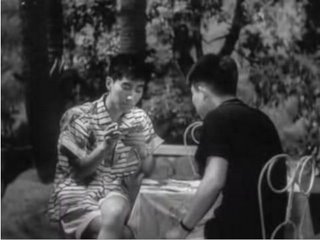
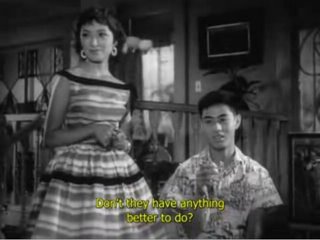
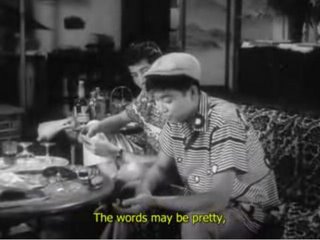
The lack of compositional tension in the shots can partly be chalked up to the emotionally neutral content of the scene: none of the characters in these two-shots have a strong personal relationship to each other. Nonetheless, the layout of these shots has a cerebral quality to me: the two figures in the frame are just large enough that the frame seems to be about them and little else. The background is visible in the shots, and even has some visual appeal in the second shot; but for me the size of the people in the frame sends a signal that the background isn’t motivating the placement of the camera.
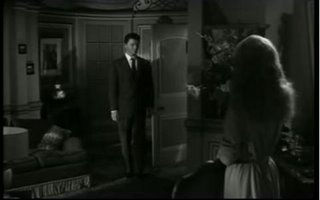
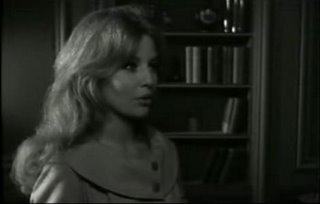
The Vadim clip is longer, so it provides more varied examples. And the emotional tension between Valmont and Marianne is at a high point, which to some extent mandates additional diagonal tension. Here are a few two-shots in this scene that are relatively free of diagonal tension, and therefore compare better to Nakahira’s two-shots:
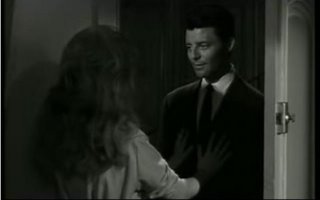
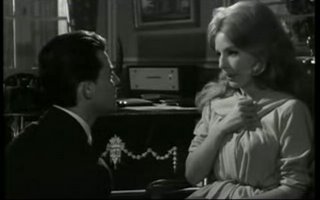
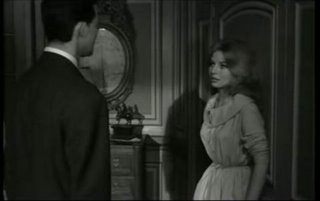
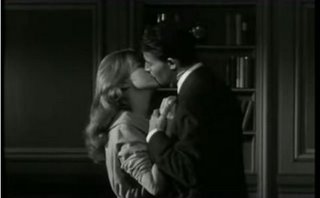
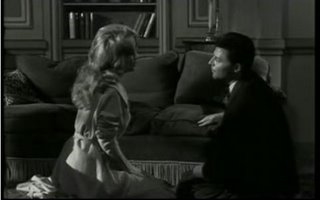
Allowing for the wider aspect ratio that Vadim uses, and also for Vadim’s use of deep focus, these shots aren’t wildly different from Nakahira’s. (The deep focus is, of course, not irrelevant to this discussion: it’s certainly an invitation to experience the characters as part of the environment. I don’t know much about Vadim’s director of photography here, Marcel Grignon. He seems to have had a long career in the European film industry, but I recognize only a few of his credits, principally Clement’s Paris brûle-t-il? and Borowczyk’s La Bête. He worked with Vadim once again, in 1963 on Le Vice et la vertu.) I perceive a greater tendency in Vadim to arrange his actors to create a sort of human terrain, a landscape with perspective and contour.
Other two-shots in the scene make greater use of distance and diagonality:
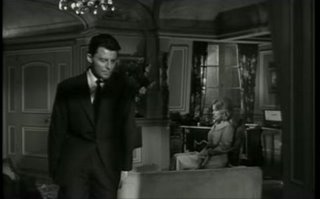
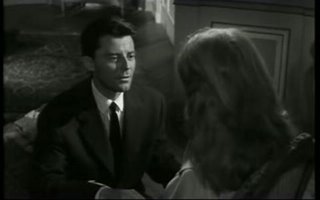
Here we see an interest in the environment that doesn’t have a parallel in the Nakahira scene. The deep focus in these shots is clearly part of a plan to photograph the texture and the space in the room, while configuring the actors in dramatic opposition to each other. There is very little in the story that draws our attention to the setting: Vadim could easily have conceived the scene as an abstract personal confrontation, but he seems to think naturally in terms of topography.
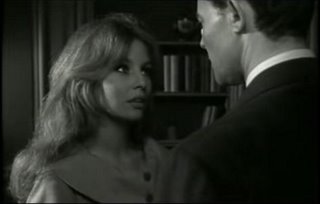
Finally, a few closer two-shots drive home the idea of actors as terrain:
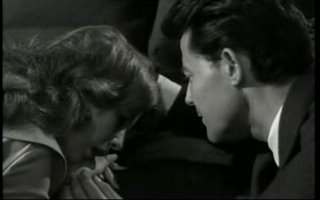
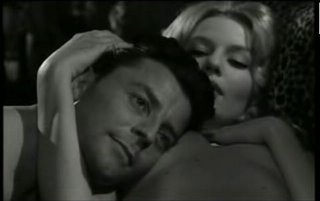
There is not much in the way of background in these shots, but the people are invested with spatial qualities of their own. I often thought of mid-period Antonioni when watching Les Liaisons dangereuses; it didn’t occur to me until afterwards that the film was released nine months before L’avventura, the film that popularized Antonioni’s wide-screen compositional style.
Now for one-shots. The scene I’ve chosen from Kurutta kajitsu centers on a Soviet-inspired montage sequence that cuts among a number of tight closeups, usually with tilted compositions:
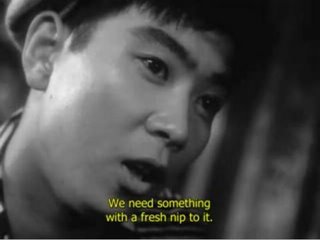
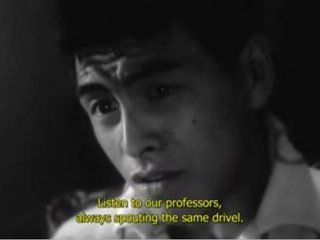
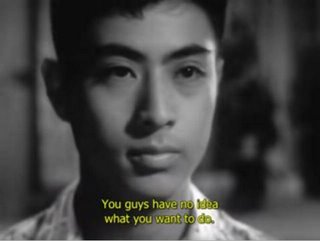
The composition that isn’t tilted is the closeup of the straight-arrow brother, whereas the tilted closeups go to the “taiyozoku.” This correspondence between composition and characterization is way too blatant to have any resonance for me.
The scene contains a few one-shots that are more conventional:
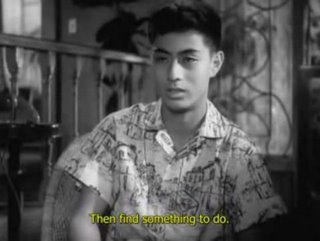
Again, Nakahira frames simply, with no apparent intention other than to show the actor. There is some visual tension in the background with the wooden railing; the direct framing of the boy again discourages me from registering him in his environmental context.
Vadim’s simplest one-shots aren’t much more complicated:
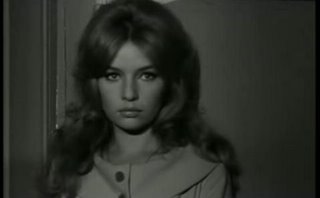
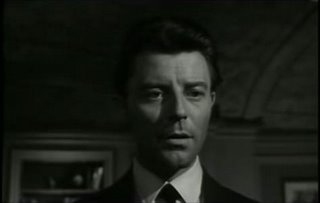
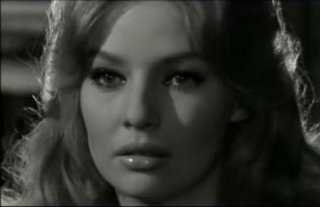
Most of the added environmental presence can be chalked up to the wider aspect ratio and the use of deep focus. Often, however, Vadim clearly shows a desire to situate the characters amid their decor, even with the limited amount of screen acreage available to show background in one-shots:
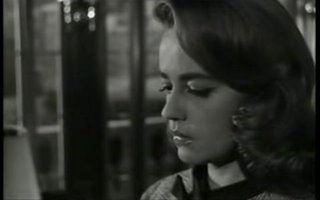

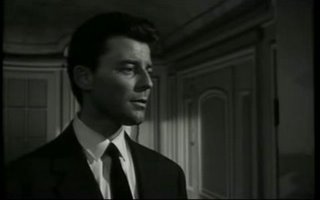
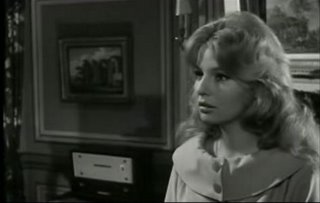
The wider aspect ratio gives Vadim greater opportunity to place actors off-center and highlight the décor, Antonioni-style.
As with the two-shots cited earlier, some of the one-shots strongly suggest the topographical qualities of the bodies of the actors:
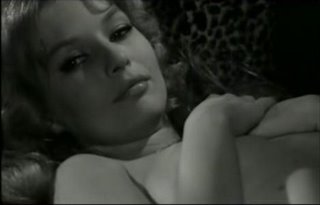
At one point, Vadim creates an off-center composition around Marianne, then moves Valmont into the frame for a more massed, topographical effect. Practically the same framing serves both halves of the shot, which suggests that Vadim’s compositions are friendly to the absence of the actors as well as their presence.
I haven’t seen Vadim’s 1957 Sait-on jamais... (No Sun in Venice), but it's often cited as one of Vadim's best (Godard reviewed it favorably in Cahiers), and it screens at MOMA in the Jazz Score series on Monday, June 16 at 6 pm and Wednesday, June 18 at 6:45 pm.
(The historically appropriate pairing of these films isn’t pure coincidence. The Cahiers critics of the time seemed to take a special interest in films about youth: possibly because the subject matter encouraged a freer directorial style; possibly also because the Cahiers writers were young themselves and trying to foment a revolution. The Nakahira and Vadim films were both part of MOMA’s Jazz Score series – and jazz music and youth subjects went hand in hand in films of the 50s.)
Truffaut, whose review of Kurutta kajitsu was compiled and translated into English in My Life and My Films, made the connection between Nakahira and Vadim:
"In short, you will have guessed, Ishihara (Editor’s note: screenwriter Shintarô Ishihara, the central literary figure of Japan’s 50s “taiyozoku” youth culture) is called in Poland the Marek Hlasko of Japan, and in France the Sagan/Vadim/Buffet of Japan. The second is certainly warranted, since it seems clear that Juvenile Passion was influenced by And God Created Woman (Et Dieu...créa la femme), which played in Japan at the same time it was released in France.
"As in Vadim’s first film, we are shown two brothers who are successively the lovers of a young woman unhappily married to an American. I find the Japanese film superior to its French model from every point of view: script, direction, acting, spirit."
The Cahiers writers would always define Vadim by Et Dieu...créa la femme, which fascinated them upon its 1956 release, and seemed to them to point the way toward a new and freer cinema. It’s not the Vadim film that appeals to me most. Still, I think Vadim’s now-depressed reputation deserves a lift, and I certainly thought he got the better of Nakahira in that evening’s faceoff at MOMA.
One of the appeals of Kurutta kajitsu is that the characters are rebellious enough to confound certain genre expectations. The enigmatic female lead (Mie Kitahara, seen in NYC recently in Tomu Uchida’s memorable Jibun no ana no nakade [A Hole of My Own Making]) plays a triple game as wife, innocent, and slut, but is not typed as duplicitous: the film suggests that her desires are sincere in each compartment of her life. And the older brother (Yûjirô Ishihara) betrays his sibling, not from malevolence or weakness, but from impulsiveness wedded to a reckless existentialism. Director Nakahira makes unusual and vigorous attempts to convey the subjective experiences of the characters, using point-of-view shots and focusing on small-scale events to associate the boys’ lives with immediacy and sensation.
Still, Nakahira strikes me as stronger on big concepts than on moment-by-moment direction. Too often his performers fall back on conventional signposting within each scene, even when the characters don’t reduce to simple concepts. (Chabrol corrected this shortcoming in 1959’s Les Cousins, which could be seen as a loose reworking of Kurutta kajitsu.) And I don’t find Nakahira a visually expressive director: he manages a number of attractive shots, mostly in exteriors, but produces unremarkable results with basic tasks like cutting between characters or laying out simple action.
The simple scenes in Les Liaisons dangereuses are exactly where Vadim establishes his talent. His compositions and camera movements have great natural beauty, and also preserve a balance between subjectivity and an objective, environmental perspective. The now-familiar source material (I haven’t read Laclos’ novel, but I feel as if I have after seeing at least four adaptations of it) opens an intriguing gap between the malevolence of the protagonists and their more conventional sentimental aspirations, and Vadim and his writer Roger Vailland are intuitive enough to enhance the emotional gravity that accompanies the characters’ nasty gamesmanship. The best example of this approach is the stunning scene in which Valmont (Gérard Philipe) presses his courtship of the chaste Marianne (Annette Vadim) while they walk amid snowy mountains at a winter resort. Valmont’s seduction strategy, described in voiceover, is to tell Marianne the truth about his life of depravity; and so the scene plays with a built-in dual perspective, according to which Valmont makes both a calculating power play and a naked confession to a woman who is already more than just a victim to him. Vadim plays the scene for maximum solemnity, letting Valmont’s words resonate in the majestic spaces that shift behind the characters, and keeping his camera a little low and far enough away from the couple that their figures never completely eclipse the elemental environment.
Throughout the film, Vadim’s innate seriousness makes it possible for him to give the cruelty of the subject matter its full weight, neither softening it (cf. the Forman/Carrière and Kumble versions of the story) nor implicating himself in it (cf. the Frears/Hampton version). This is not to deny a certain number of missteps, mostly near the ending, possibly attributable to internal or external censorship. One can see Vadim as divided between a fruitful iconoclasm and a more conventional or conformist tendency. (If film criticism has tended to regard Vadim as the cinema’s answer to Hugh Hefner…well, Hefner too is half revolutionary and half conformist, and his career declined in the same precipitous fashion.)
Before I insert images into this blog for the first time, I’m going to make a tentative attempt to generalize some of the above comments about composition. When I watch a movie and think, “These images are intrinsically beautiful – this director really knows how to compose,” and then try to analyze the visual style, I often conclude that the compositions are balanced between two functions: showing the figure in the foreground, and showing the world. The balance is always managed in such a way that the shot can still function in the mind of the viewer as a depiction of the foreground figure; and yet the room or landscape is presented with some spatial integrity.
And every time I watch a movie and think, “These images are dull and conventional,” I conclude upon further analysis that the compositions are framed as if they are trying to present only one object, or one idea, and that the image reduces in my mind to a concept. Closeups are composed to show the person and not much else; longer shots are far enough back that the relation of the object or person to the surroundings seems to motivate the composition. I don’t necessarily think that shots that fit this description are a liability, but they miss out on intrinsic beauty, because they suggest a concept too strongly. In some cases shots like these gain value from being part of a larger artistic structure.
I was first put onto this train of thought when I attended another circumstantial double bill at MOMA of Mankiewicz’s House of Strangers and Fregonese’s Black Tuesday. I felt as the films had utterly different visual agendas: it seemed to me that every shot in the Mankiewicz film had a single concept behind it, and could be translated into words without loss; and that every shot in the Fregonese film was a picture of the world, with its complexity preserved.
I don’t have DVDs of Kurutta kajitsu or Les Liaisons dangereuses, so I’ll compare still images from the films that I found on YouTube. From the very limited selection of clips available, I chose two fairly unremarkable interior scenes: a teen party from Kurutta kajitsu in which the representatives of reckless youth state their credo; and the culmination of Valmont’s attempt to seduce Marianne in Les Liaisons dangereuses. The scenes have different emotional trajectories (not to mention different aspect ratios) and therefore don’t compare perfectly, but they do give a sense of Nakahira and Vadim’s compositional tendencies.
Let’s compare two-shots first. The Nakahira scene is heavy on closeups, but it contains a few two-shots:
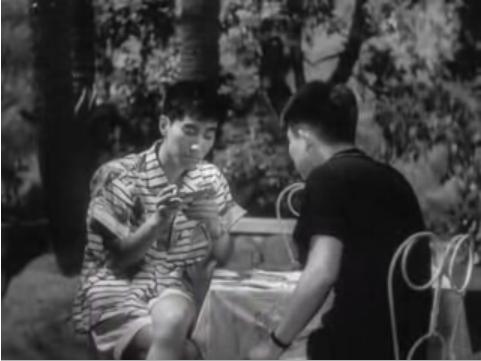
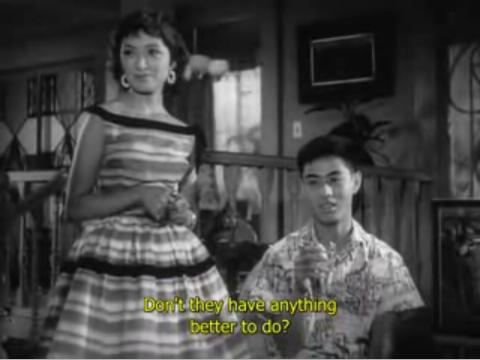
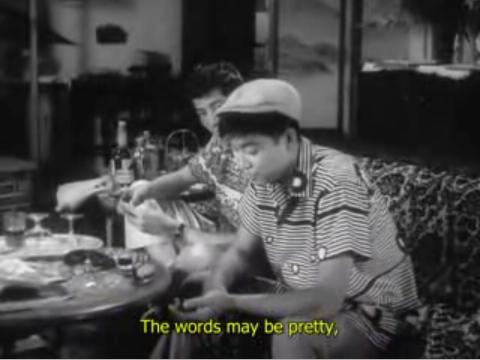
The lack of compositional tension in the shots can partly be chalked up to the emotionally neutral content of the scene: none of the characters in these two-shots have a strong personal relationship to each other. Nonetheless, the layout of these shots has a cerebral quality to me: the two figures in the frame are just large enough that the frame seems to be about them and little else. The background is visible in the shots, and even has some visual appeal in the second shot; but for me the size of the people in the frame sends a signal that the background isn’t motivating the placement of the camera.
The Vadim clip is longer, so it provides more varied examples. And the emotional tension between Valmont and Marianne is at a high point, which to some extent mandates additional diagonal tension. Here are a few two-shots in this scene that are relatively free of diagonal tension, and therefore compare better to Nakahira’s two-shots:
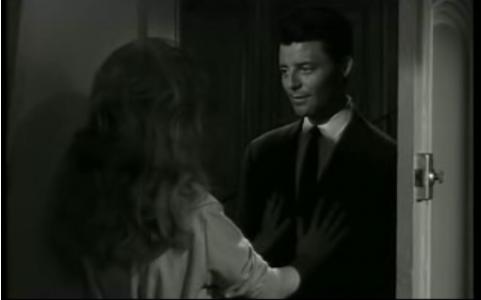
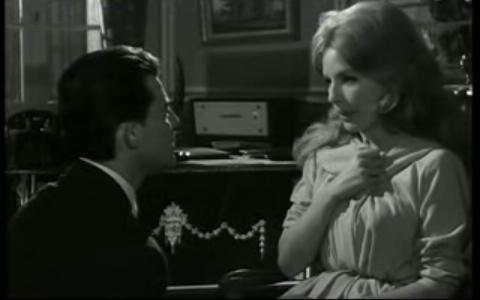
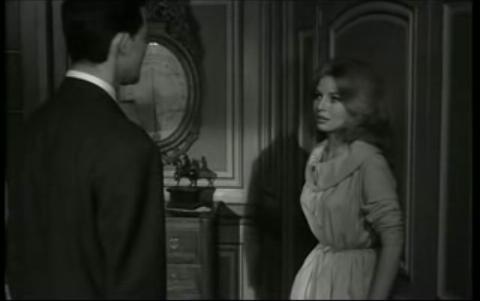
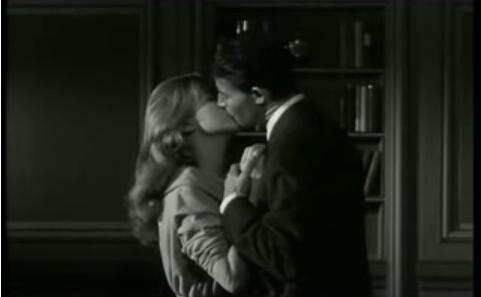
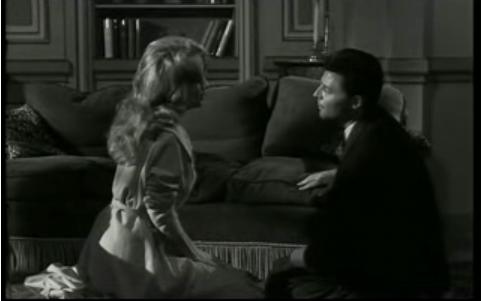
Allowing for the wider aspect ratio that Vadim uses, and also for Vadim’s use of deep focus, these shots aren’t wildly different from Nakahira’s. (The deep focus is, of course, not irrelevant to this discussion: it’s certainly an invitation to experience the characters as part of the environment. I don’t know much about Vadim’s director of photography here, Marcel Grignon. He seems to have had a long career in the European film industry, but I recognize only a few of his credits, principally Clement’s Paris brûle-t-il? and Borowczyk’s La Bête. He worked with Vadim once again, in 1963 on Le Vice et la vertu.) I perceive a greater tendency in Vadim to arrange his actors to create a sort of human terrain, a landscape with perspective and contour.
Other two-shots in the scene make greater use of distance and diagonality:
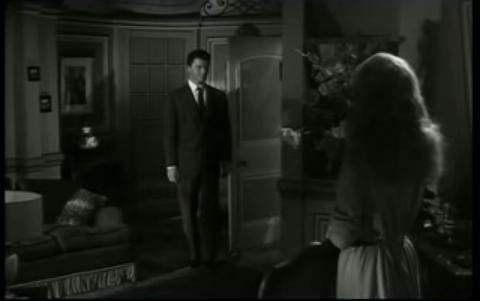
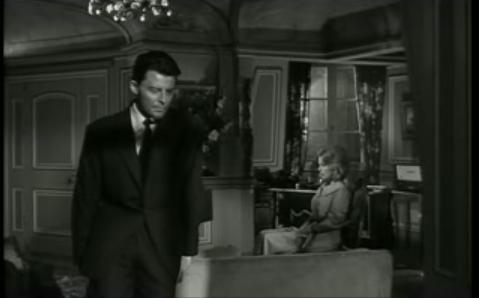
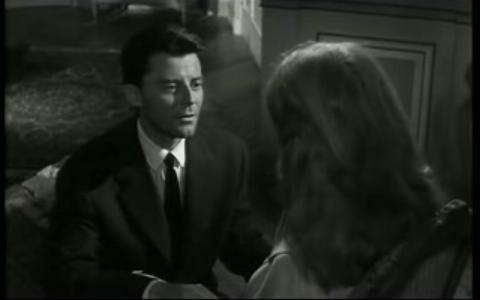
Here we see an interest in the environment that doesn’t have a parallel in the Nakahira scene. The deep focus in these shots is clearly part of a plan to photograph the texture and the space in the room, while configuring the actors in dramatic opposition to each other. There is very little in the story that draws our attention to the setting: Vadim could easily have conceived the scene as an abstract personal confrontation, but he seems to think naturally in terms of topography.
Finally, a few closer two-shots drive home the idea of actors as terrain:
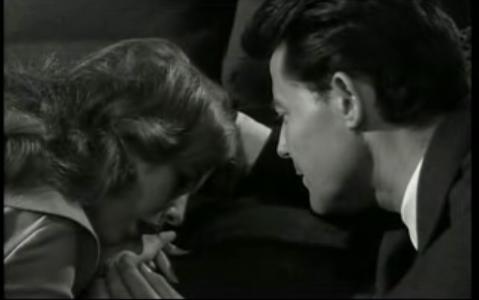
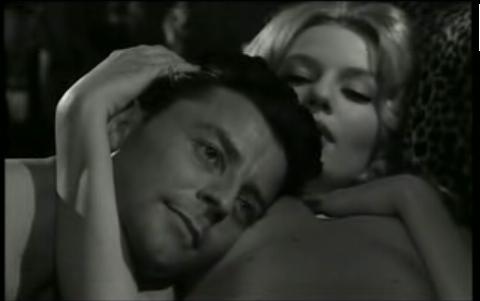
There is not much in the way of background in these shots, but the people are invested with spatial qualities of their own. I often thought of mid-period Antonioni when watching Les Liaisons dangereuses; it didn’t occur to me until afterwards that the film was released nine months before L’avventura, the film that popularized Antonioni’s wide-screen compositional style.
Now for one-shots. The scene I’ve chosen from Kurutta kajitsu centers on a Soviet-inspired montage sequence that cuts among a number of tight closeups, usually with tilted compositions:
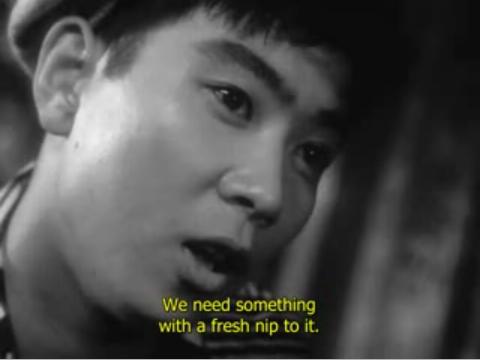
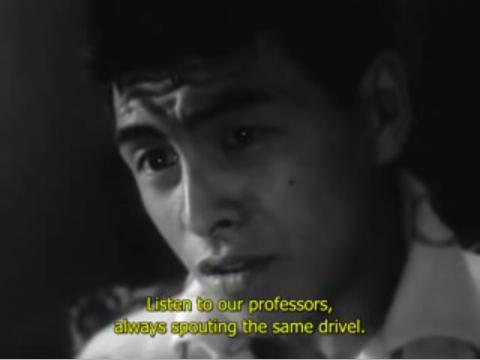
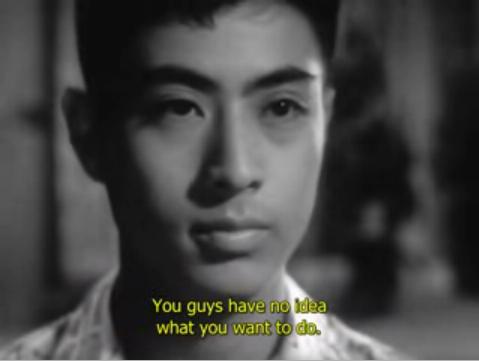
The composition that isn’t tilted is the closeup of the straight-arrow brother, whereas the tilted closeups go to the “taiyozoku.” This correspondence between composition and characterization is way too blatant to have any resonance for me.
The scene contains a few one-shots that are more conventional:
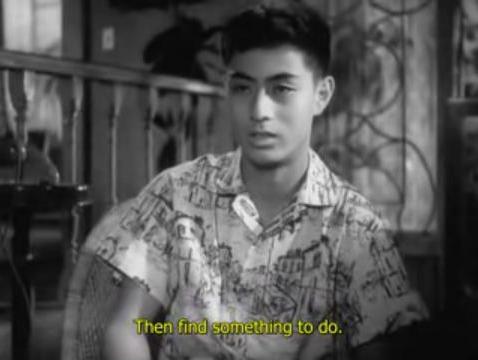
Again, Nakahira frames simply, with no apparent intention other than to show the actor. There is some visual tension in the background with the wooden railing; the direct framing of the boy again discourages me from registering him in his environmental context.
Vadim’s simplest one-shots aren’t much more complicated:
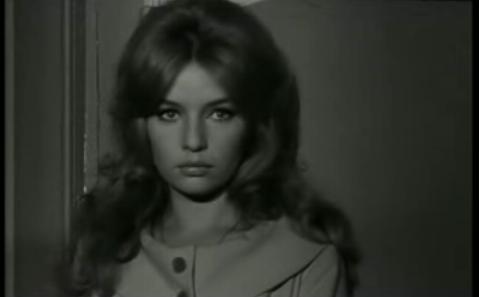
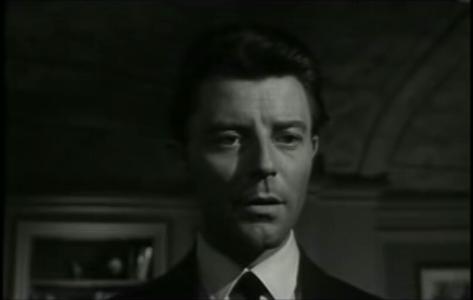
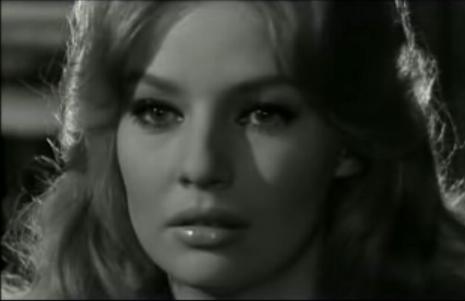
Most of the added environmental presence can be chalked up to the wider aspect ratio and the use of deep focus. Often, however, Vadim clearly shows a desire to situate the characters amid their decor, even with the limited amount of screen acreage available to show background in one-shots:
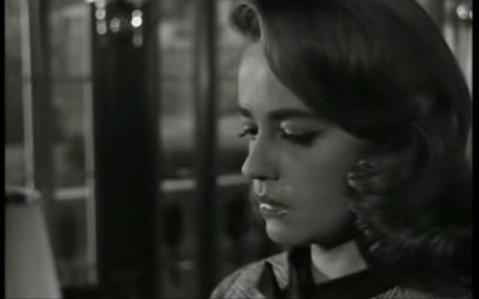
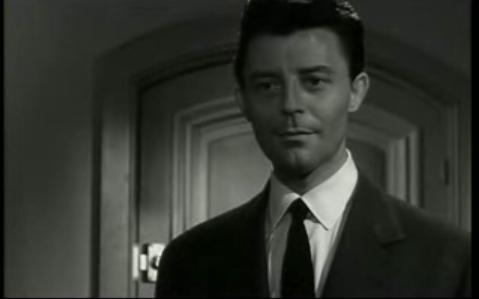
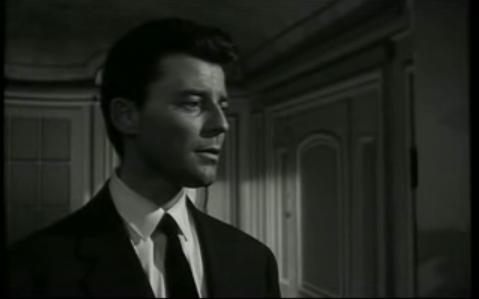
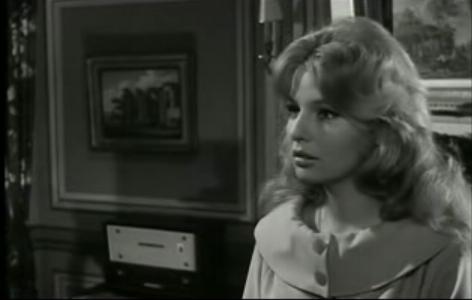
The wider aspect ratio gives Vadim greater opportunity to place actors off-center and highlight the décor, Antonioni-style.
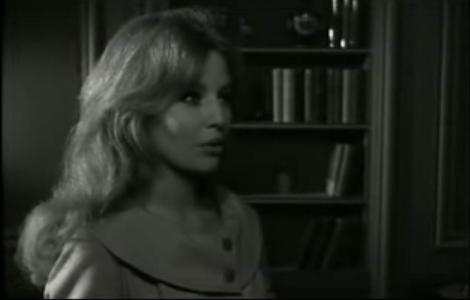
As with the two-shots cited earlier, some of the one-shots strongly suggest the topographical qualities of the bodies of the actors:
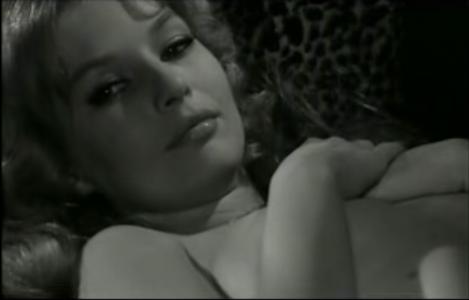
At one point, Vadim creates an off-center composition around Marianne, then moves Valmont into the frame for a more massed, topographical effect. Practically the same framing serves both halves of the shot, which suggests that Vadim’s compositions are friendly to the absence of the actors as well as their presence.
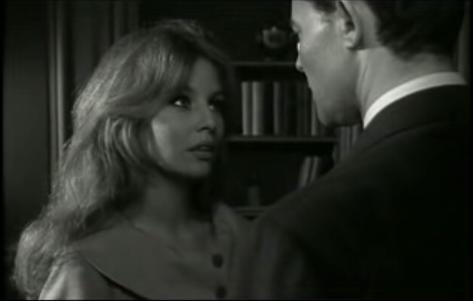
I haven’t seen Vadim’s 1957 Sait-on jamais... (No Sun in Venice), but it's often cited as one of Vadim's best (Godard reviewed it favorably in Cahiers), and it screens at MOMA in the Jazz Score series on Monday, June 16 at 6 pm and Wednesday, June 18 at 6:45 pm.
Darling
A few weeks ago I took a chance on Swedish director Johan Kling's Darling when it screened at Scandinavia House, because the trailer looked interesting. I loved the movie, and wrote a short review that's up at the Auteurs' Notebook. As far as I can tell, Darling is available only on Region 2 DVD with no English subtitles - but I wouldn't be surprised if Kling has his day soon.
Tuesday, May 27, 2008
Ballast: BAM, May 31, 2008
Lance Hammer’s American art film Ballast, which premiered at Sundance this year, gets a NYC theatrical release from IFC Films on August 29. But you can preview it this Saturday, August 31 at 9 pm when it screens in BAM’s Sundance series. A quiet fable of despair and salvation among the impoverished residents of the Mississippi Delta, Ballast is visually overwhelming from its first shot: the camera work is simple and direct, but the natural light of the overcast delta gives Hammer’s widescreen, horizon-line compositions a palpable realism. (Is conventional film lighting necessary at all? Seems to me that most of the really dazzling effects I see are the result of imperfections that point up the limitations of the photographic image.) The first movement of Ballast, jumping mysteriously between solid blocks of image and sound that allude to the story rather than narrate it, is sublime: a documentary stalked by a horror film, a subtle infusion of naturalism with the uncanny. If the film ultimately settles into a more conventional form of storytelling, it retains an exciting connection with the intractable personalities of its non-professional performers and the darkling barrenness of the terrain. The proof of Hammer’s artistic intuition is that he hinges the story’s climax on a magical event that only a committed realist could get away with; the proof of his artistic commitment is that he lets the film’s bleak setting and ominous imagery have their way with the potentially heartwarming ending.
Monday, May 26, 2008
Late Marriage: Walter Reade, May 28 and 31, 2008
Dover Koshashvili's remarkable 2001 debut has, I believe, not had a NYC screening since its 2002 theatrical run, and is in some danger of being forgotten. The story, about the fierce resistance that an Georgian family in Israel puts up when its son (Lior Ashkenazi) falls in love with an Israeli divorcee (Ronit Elkabetz), primes the audience for a Romeo-and-Juliet-style, love-conquers-all drama. Instead of triumph or tears, however, we get a grueling analysis of the mechanics of social pressure, which thrives on the divided feelings of its targets, and which seems even more formidable here because of its psychological fluidity. Koshashvili stages the film in five or six large set pieces, played out in continuous time and space, but with large gaps in between. The structure made me think of Dreyer's Gertrud - and once that association was in my head, I also picked up more than a hint of Dreyer's quiet implacability in the way that Koshashvili observes the emotionally charged situation without endorsement, as if there were no point in rooting or protesting. Late Marriage screens twice in the Walter Reade's Israel at 60 series: on Wednesday, May 28 at 4:15 pm, and Saturday, May 31 at 9:20 pm.
If you don't have a 9-to-5 job, you should also pay a visit to Keren Yedaya's daringly stylized 2004 Or (My Treasure), screening Monday, June 2 at 4:15 pm and Wednesday, June 4 at 4:30 pm. To my mind, these are the two finest films that Israel has produced.
If you don't have a 9-to-5 job, you should also pay a visit to Keren Yedaya's daringly stylized 2004 Or (My Treasure), screening Monday, June 2 at 4:15 pm and Wednesday, June 4 at 4:30 pm. To my mind, these are the two finest films that Israel has produced.
Subscribe to:
Posts (Atom)