Sunday, January 4, 2026

2025 Theatrical Releases

I kind of have a good excuse for missing so many one-week theatrical releases this year, as I shot a movie in October and have been editing it. But that doesn't make it feel any better. Here's a five-best list:

  1. Eephus (Carson Lund)
  2. Peter Hujar’s Day (Ira Sachs)
  3. Sound of Falling (Mascha Schilinsky)
  4. Invention (Courtney Stephens)
  5. Nouvelle Vague (Richard Linklater)
Runners-up would be Parthenope (Paolo Sorrentino) and 7 Walks with Mark Brown (Vincent Barré and Pierre Creton). There were a lot of very good theatrical releases that I deemed too old for inclusion.


Tuesday, April 22, 2025

2023 and 2024 Theatrical Releases

Wow, I guess I haven't been keeping this blog up at all. Okay, let's at least backfill the last two end-of-year favorite film lists.

2023 was a weirdly thin year for me, at least in terms of theatrical one-week runs. In fact, I think I'd rather do a five-best than a ten-best list.

  1. Walk Up (Hong Sang-soo)
  2. Nobody's Hero (Alain Guiraudie)
  3. Rise (Cédric Klapisch)
  4. Tori and Lokita (Jean-Pierre & Luc Dardenne)
  5. Vera (Tizza Covi & Rainer Frimmel)
I would fill this list out with some subset of the following films, which are listed in alphabetical order: Anatomy of a Fall (Justine Triet), Barbie (Greta Gerwig), Fallen Leaves (Aki Kaurismäki), The Holdovers (Alexander Payne), Men of Deeds (Paul Negoescu), Passages (Ira Sachs), Past Lives (Celine Song), and Winter Boy (Christophe Honoré). There are some belated theatrical releases that I deem too old, like Kira Muratova's Brief Encounters (1967) and Mikko Niskanen's Eight Fatal Shots (1972).

2024 looked a little better, although that's due to the vagaries of theatrical distribution - a lot of the below films were first screened in 2023: 

  1. The Feeling That the Time for Doing Something Has Passed (Joanna Arnow)
  2. Last Summer (Catherine Breillat)
  3. This Closeness (Kit Zauhar)
  4. Un Prince (Pierre Créton)
  5. Matt and Mara (Kazik Radwanski)
  6. You Have to Come and See It (Jonás Trueba)
  7. The Shadowless Tower (Zhang Lu)
  8. I'll Be Your Mirror (Bradley Rust Gray)
  9. Slow (Marija Kavtaradze)
  10. Santosh (Sandhya Suri)
Releases I deem too old for this list include Shinji Sômai's Moving (1993) and Lee Chang-dong's Peppermint Candy (1999) and Green Fish (1997).


Sunday, January 1, 2023

2022 Theatrical Releases

Weird year for me, with an odd shortage of new releases I liked, but a slightly fuller list of first-time NYC theatrical releases. (I arbitrarily excluded theatrical releases that felt too old, including Face [Tsai Ming-Liang, 2009] and Vengeance Is Mine AKA Haunted [Michael Roemer, 1984].) In approximate order of preference:
  1. Outside Noise (Ted Fendt)
  2. Actual People (Kit Zauhar)
  3. Deception (Arnaud Desplechin)
  4. One Fine Morning (Mia Hansen-Løve)
  5. The Cathedral (Ricky D’Ambrose)
  6. Peaceful (Emmanuelle Bercot)
  7. In Front of Your Face (Hong Sang-soo)
  8. Emily the Criminal (John Patton Ford)
  9. Wood and Water (Jonas Bak)
  10. Hallelujah: Leonard Cohen, a Journey, a Song (Dan Geller & Dayna Goldfine)
It could be that Return to Seoul (Davy Chou) belongs on this list, but I need to see it again to focus my reaction. Runners-up include The Girl and the Spider (Ramon & Silvan Zürcher) and Memory Box (Joana Hadjithomas & Khalil Joreige).

Wednesday, January 5, 2022

Alan Rudolph: The Only True Romantic Left in This Building


In June 2018, I was invited to speak at an event at the University of Michigan in honor of Alan Rudolph, whose films are housed in Michigan's archive. I'd already written a monograph on Rudolph in 1985; my talk in Michigan drew on my old ideas, but was an attempt to build an understanding of Rudolph starting from particulars, by making a list of the motifs and qualities that recur through his 45-year career. My notes for the talk look almost like an essay: here they are, with minimal revision.  

====

In 1985 the Toronto Film Festival (or the Toronto Festival of Festivals, as it was known then) planned a book publication in conjunction with its “10 to Watch” sidebar program featuring ten emerging directors. Alan Rudolph, fresh from the success of Choose Me, was selected as one of the featured filmmakers - but Toronto had difficulty finding a Rudolph partisan to write a 40-page monograph. Dave Kehr of the Chicago Reader happened to know that I admired Rudolph and recommended me, and I don’t believe I had any competition for the job. (The book was never published, but a greatly truncated version of the monograph appeared in the Toronto catalog.)

I had a chip on my shoulder about Rudolph back then. I wrote in the monograph, “That the achievements of Welcome to L.A. and Remember My Name were not greeted with widespread critical acclaim can be chalked up to taste; that they passed almost unnoticed comes close to discrediting American film criticism altogether.” I even took a little indirect swipe at my employers: “The Los Angeles Film Critics Association insulted Rudolph with its ‘New Generation’ award, almost a decade after the one-two combination of Welcome to L.A. and Remember My Name established him as one of the most important talents of the seventies.”

My distinct impression at the time was that Rudolph’s films were a hard sell, and that a lot of viewers were rubbed the wrong way in the 70s and 80s by his combination of expressionistic romanticism and amused detachment. “Welcome to L.A., the best known of Rudolph's films before Choose Me, is a risky subject for casual conversation, often stirring bitter memories of wasted admission fees for which we Rudolph defenders are somehow held accountable.” It’s difficult to document this antipathy now. My memory is that critics of the time tended to be modestly favorable on early Rudolph, though few or none were committed enough to keep the films in the public consciousness. Rudolph’s association with Robert Altman was front and center in most reviews, and critics usually discussed the films as emanations from the Altman universe.

Something may have changed since then. Young cinephiles no longer seem troubled by Rudolph’s films when they discover them - which still isn’t as easy as it might be, thanks to uneven distribution. Film internet buzz about Rudolph has been steady and affectionate for many years, and widespread enthusiasm greeted the recent Rudolph retrospective at the Quad Cinema in New York. Part of this improvement (assuming I’m reading the signs of change correctly) is surely due simply to the passage of time and the accumulation of individual films into a coherent career achievement. But I can’t help feeling that the zeitgeist has also shifted in a way that favors Rudolph. The year before Choose Me, Jim McBride’s remake of Breathless came out to near-universal scorn and dismissal. It shares a few qualities with Rudolph’s work: bright colors, an acceptance of overt artifice, lively rhythms, light-hearted detachment from a potentially serious story. It too is now widely if not universally respected. The 80s and 90s saw the rise of Hong Kong action cinema, then of Quentin Tarantino, both of which ratified a reflexive, pop approach to genre that Rudolph, in his own way, had accomplished years before. On the art-film circuit, Hal Hartley, who is to Godard as Rudolph is to Altman, accumulated a sizable fan base with a sensibility that overlaps Rudolph’s in a number of areas. My guess is that Rudolph’s films are not the only artifice-reliant, reflexive works of recent decades that would look better to today’s filmgoers than they did at the time. (For instance, I suspect that Claude Chabrol’s universally dismissed genre work for hire in the late 60s is due for reevaluation.)

Hanging out in the lobby of the Quad after last month’s Rudolph screenings, one could readily observe the surprise of young cinephiles that so distinctive a filmmaker, who bucks convention in so many different ways, would not have received greater acclaim. In the years since I wrote my monograph, my view of film authorship has shifted slightly: whereas once I tended to think of powerful filmmakers as master strategists who calculated their effects, I now tend to see their artistry as a collection of personal predilections expressed forcefully. Obviously both models are true at the same time, or can be...but the latter better explains the almost helpless consistency of the filmographies of so many important artists. In any case, as an afterword to my old monograph, here’s a little list of filmmaking decisions that Rudolph makes so often that they feel like urgencies.

A desire to expose the fiction as fiction

  • Sometimes this desire is blatant: as when characters look directly at the camera at the end of scenes, a running practice in Welcome to L.A. that makes a comeback in Ray Meets Helen (via Andre, the boy who befriends Ray).
  • Usually it’s subtler, as with the exaggerated use of coincidence and repetition. Choose Me took this tendency as far as it could go: the symmetry of the hookups is like a game the audience is invited to play. We see it again in Ray Meets Helen, with the same building as the residence or the focus of all five main characters.
  • A similar tendency is the re-use of a small number of locations, with the same characters present each time we see the location: almost a commentary on making films with limited resources. There are many examples: Mr. Nudd’s drugstore in Remember My Name, Eve’s bar in Choose Me, the café in The Moderns, the bar near the staked-out ranch in Love at Large.
  • Dialogue: characters often do the work of categorizing themselves. For instance, Tyra Ferrell’s morgue attendant in Equinox signals her ambition: “This story is going to raise me up out of the junk. People are going to want to sit next to me.” Similarly, Nolte underlines his character’s concept with his many references to finance in Investigating Sex. (Rudolph has this tendency in common with Hartley, by the way.)
  • References to genre, and genre dialogue, are often so exaggerated that they are necessarily reflexive: the Fat Adolph story in Trouble (Bujold says, “If it was evil, he was into it”), the entire presentation of Anne Archer’s femme fatale in Love at Large.
  • Characters who deviate from our expectations in order to collaborate in creating the film’s tone. A good example is John Hawkinson’s unpleasant cop in Ray Meets Helen, who quickly becomes a bit of a philosopher: “We’re all wearing masks.”
  • A purification of gesture that resembles choreography: the violence of the passengers in the crowded bus in Equinox; or Tomei putting Modine’s hand on her breast in the same film. (This is another characteristic that Rudolph and Hartley share.)
  • Music: of course there’s the obvious reflexivity of the studio musicians in Welcome to L.A., who are shown creating the soundtrack music. But there are also uses of music that are basically commentative, like the Hollywoodish music over the slapstick-y Emmet Walsh scenes in Equinox. And music that contradicts the scene’s tone in a jarring way, like the diegetic easy-listening music in the beauty salon in Mortal Thoughts that continues over the Headly-Willis fight and the poisoned coffee cup.
  • Similarly, there are times in Rudolph when humor so disrupts the drama that one registers it as a form of direct address. The film I’m thinking of that best illustrates this extremity is Trouble in Mind, where a quite serious and emotional genre story increasingly shares the screen with a campy, obstreperous humor that one would expect to banish the initial gravity. (Though of course it doesn’t.) 
  • While speaking of Trouble, we might as well mention in passing the architectural models that Kris Kristofferson’s Hawk builds, which are introduced as characterization, pass through the stage of metaphor, and end as a bit of the production designer’s work placed within the diegesis. 
Kinds of people he likes

Or puts in his films repeatedly, anyway.

  • People who stand at an amused distance from their own crises. Keith Carradine’s Carroll Barber in Welcome to L.A. is the first and best example. I wrote, “Carroll Barber walks through the emotional wreckage of Rudolph's Los Angeles at a serene philosophical distance from his own pain, smoothing out the peaks and valleys of his psyche just as Rudolph levels the film's tone with his remote but sympathetic overview. A little ironic smile creeps across Carroll's face at the slightest observation, about either himself or others; his gestures are slow and measured, sometimes consciously overstressed, as if the observer within him is amused to see essence transformed into existence by any simple act.” Another good instance is Julie Christie in Afterglow, always half-smiling and looking in on her own sorrow.
  • Transpose this detachment into a comic mode, and you get protagonists who become frustrated but manage to deal with it. Tom Berenger in Love at Large is forever perplexed at his encounters with difficult or unmanageable people: his girlfriend (Ann Magnuson), or a bizarre taxi driver. Carradine dealing with medical obstruction in Ray Meets Helen is a running joke - a rather dark one, but ultimately a demonstration of endurance; the bartender who must deal with drunken Samantha Mathis in the same movie shows the same spirit.
  • Honest people. Some Rudolph characters are explicitly labeled as honest, and fulfill their missions: Carradine’s Mickey in Choose Me, Nolte’s Lucky in Afterglow make it a point not to lie. Even apart from the obvious examples, there really aren’t many lies in Rudolph at all, which is remarkable given his affection for farce: he seems to enjoy truthfulness. Even the few liars in his films, like Geraldine Chaplin’s Emily in Remember My Name, are so poker-faced and outrageous about their lies that they practically notarize the truth.
  • Guys in Rudolph, sympathetic though they tend to be, are often comically afflicted with guyness. Jealousy and sex conflict abounds, from protagonists and antagonists alike: Patrick Bauchau in Choose Me, Keith Carradine in Trouble in Mind, The Moderns and Ray Meets Helen, John Light in Investigating Sex. Macho bluster often takes over an ordinarily balanced personality as a fight looms or subsides: Carradine sets the pattern in Choose Me (“I’m going to kill the son of a bitch”); Nolte and Jonny Lee Miller in Afterglow make a running gag of it. Carradine in Ray Meets Helen is a compendium of guy traits: instead of the expected pathos during his tale of woe, he tells young Andre “Chicks dig boxers”; his regained swagger as he tries to pick up Locke is cliché tough-guy stuff; and there’s a funny running gag of him fending off Sondra Locke’s introspection about death automatically. The most interesting variation on this theme is Hawk in Trouble in Mind: he is maladjusted and borderline criminal in the film’s first half, and Rudolph lets his ear for unregenerate masculinity write the character. Later Hawk reverts to a more typical level of testosterone for a Rudolph guy.
  • People who don’t go gently into that good night. Emily in Remember My Name doesn’t submit to being dismissed or blown off, whether by the drugstore supervisor who grabs the cigarette from her mouth or by the bartender who takes her for a prostitute. Even with her lover/superintendent Pike, Emily maintains passive resistance in every conflict until she gets her way. Henry, the less assertive of the two versions of Matthew Modine in Equinox, seems maddened by his suckerhood and becomes increasingly determined to escape it. Modine here recalls Eddie Bracken in Preston Sturges’s films, and the pluck of Rudolph’s marginalized characters is not unlike Sturges’s. As in Sturges, supporting characters also tend to restore their dignity: in Equinox, there’s the beggar who walks away from an offer of money with a poker-faced “Good luck, mister,” and the lawyer’s daughter who is at first bested by Ferrell’s strategy but comes back with a modicum of power restored. 
And then there’s a character type that deserves its own discussion: 

The Rudolph crazy

  • We get a number of variants on this type right off the bat in Welcome to L.A. The archetypal Rudolph crazy in the film is probably Sissy Spacek’s maid/prostitute, but Geraldine Chaplin’s Karen Hood, barely more in touch with reality, sends a strong pro-crazy signal by winning Carroll Barber’s romantic sweepstakes.
  • And Rudolph isn’t even playing much with comic forms yet at this point. Chaplin takes craziness further in Remember My Name, suspending the entire film in a contemplation of her unpredictability; Choose Me, with its embrace of farce, cultivates a number of varieties of craziness, with Bujold’s Nancy Love the most certifiable. (Carradine puts the film under the sign of Crazy by escaping from an asylum at the beginning.) Marisa Tomei in Equinox is a memorable later variation on the theme.
  • Of course craziness in life often has the same qualities as comedy does in fiction: displaced behavior, inappropriate repetition, etc. The Rudolph crazy helps make farce work without the lies that Rudolph generally prefers to avoid: characters whose emotions genuinely change in an unstable way are a workable basis for farce when imposture ploys are taken off the table. When Rudolph characters are only part crazy, it’s the part that serves this comic function (e.g., Mickey in Choose Me falling in love with every woman in the movie). The philosophical implication is that people don’t need artificial devices to have relationship problems.
  • Many Rudolph characters who can’t quite be described as crazy nonetheless have much in common with the Rudolph crazy. Headly in Mortal Thoughts is one such character (recall that great moment when she nearly crashes the car, completely unfazed and chewing gum), and she still functions in the film as an effective threat; Chaplin in Remember My Name can be pretty scary at times too. Lori Singer in Trouble in Mind is basically an embodiment of romantic innocence, but her childlike demeanor and clumsiness puts us at a comic distance from her and suggests the unpredictability of the Rudolph crazy. Traveling in the opposite direction, Lara Flynn Boyle in Equinox starts out as a full-blown Rudolph crazy, but effortlessly transforms into an affecting embodiment of romantic longing.

Mystery 

More than almost any other filmmaker, Rudolph seems to enjoy mystery for its own sake rather than a means.

  • Simple inaccessibility: Carradine in Welcome to L.A. is the archetype, but Lauren Hutton in the same movie functions solely as an emblem of inscrutability. Carradine in the bathtub in Choose Me is a great, pure moment of mystery.
  • Moments of mysterious pleasure: like Carradine’s sunny grin at what should be his worst moment in Welcome to L.A., when Chaplin reunites with her husband. There are many other such moments: Spacek in Welcome to L.A. taking money from Considine; Kaki Hunter’s knowing grin as she says “He’s so skinny” about Alice Cooper in Roadie.
  • The impassive onlooker, the master of ceremonies: Cedric Scott, the producer, at the console in Welcome to L.A., flipping a quarter across his knuckles; Terrence Howard sitting behind the spinning bike wheel in Investigating Sex.
  • Mystery of the image, images that contain barriers to looking: fuzzy TV images of Demi Moore in Mortal Thoughts; Carradine through the blurry windshield at the end of Trouble in Mind.
  • Mysterious transformation: my favorite is Berry Berenson chain-smoking and talking tough at the end of Remember My Name; of course, there’s Carradine’s incongruous glam makeover over the course of Trouble in Mind.
  • Unpredictability of behavior - which connects us back to the Rudolph crazy. A good example among many: the scene of Chaplin tearing up the flower garden in Remember My Name, an act rendered mysterious by slow, eccentric rhythms.
The pleasure of genre

  • Genre sometimes functions as a wink: we aren’t supposed to feel the oppressiveness of film noir in Love at Large, for instance. Big performances and obvious borrowings have the effect of distancing us from genre here: Archer’s slinky voice, the close-ups of her lips talking on the phone. Sometimes a small dose of genre is a light-hearted or familiar pleasure to ward off heaviness: Hilly Blue’s henchmen in Trouble in Mind come to mind, maybe even the threatening car full of joyriding boys in Mortal Thoughts.
  • Even in such cases, though, the wink is partial. Love at Large keeps genre play alive even as it gets serious, and puts the sincere love story into relation with the genre elements: e.g., Berenger’s rejection of Archer’s proposition: “It would be as thrilling as winning the exacta, but I’m in love with someone else.” Remember My Name uses comedy to distance us from the pain implicit in the genre story, but certainly doesn’t disown the pain; Equinox is wildly comic but basically delivers on all its genre expectations. Trouble in Mind is an unusual instance: a very serious genre story disrupted by a campy one, but not displaced by it - its ending is as full-bodied in its emotionality as genre gets.
  • It’s worth noting here that Rudolph’s action scenes are consistently very good, often highly choreographed, somewhat conceptual, not much like the ambient action direction of the Avid generation. Endangered Species hinted at his flair for action, which burst forth in the three Carradine-Bauchau fight scenes in Choose Me, was further demonstrated in the Nolte-Miller brawls in Afterglow, and perhaps peaked with Dermot Mulroney’s one-sided fight with John Light in Investigating Sex. An interesting variation is Love at Large’s barroom brawl between Kevin O’Connor and Ted Levine, the action a backdrop to the revelations of the men’s conversation.
Less is not more

Rudolph is extra, not basic.

  • Camera: the omnipresent camera moves seem like a first principle rather than a reaction to material. Give Rudolph a mirror or a TV monitor and he’ll use it to pan or track from one representation of reality to another - there are many examples; even the somewhat calmer camera in Ray Meets Helen hits those mirrors at every opportunity. The camera’s freedom pretty much excuses it from service to plot and genre, and this separation harmonizes well with the detached perspective and self-awareness that Rudolph cultivates in different ways. 
  • Gels, colored light: again, it feels as if he slaps the gels on first and asks questions later.
  • Decor: generally pretty wild. Salient examples: the red apartment with blue painting in Afterglow; the smoked-out period ambience of The Moderns; the crazy nightclub and Hilly’s banquet in Trouble in Mind, which arrive at camp.
  • The telephoto haze: a world of long lenses, tight frames, and compressed foreground-background perspective. It’s part of Rudolph’s link to Altman, and is usually coupled with aural omnipresence.
  • Wildly exaggerated acting: Jennifer Jason Leigh in Mrs. Parker, Berenger in Love at Large, Considine in Trouble in Mind, nearly everyone in Breakfast of Champions and Roadie.

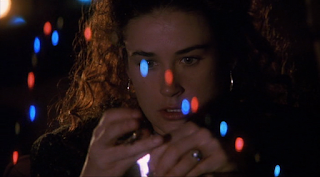
Rudolph’s effects are generally in the service of his romanticism - or perhaps it’s more capital-R Romanticism in its focus on subjective emotion. His work is a tapestry of larger-than-life effects that offer us pleasure and beauty. A few of the most vivid: the track-ins to devastated but smiling Carradine in Welcome to L.A.; Remember My Name’s decor-drenched drinking scene; the light coming up on Kristofferson’s face at the beginning of Trouble in Mind; phantom Neve Campbell haunting Dermot Mulroney’s onanistic reverie at the end of Investigating Sex. A detail that struck me as emblematic of Rudolph’s sensibility: at the most noir moment of Mortal Thoughts - which is pure film noir at the script level at least - Rudolph’s choice of expressionist effect is to reflect a string of brightly colored Christmas-y lights in Demi Moore’s windshield. I can’t think of another filmmaker who would give us that kind of direct pleasure at that particular point in that particular story.

Tuesday, January 4, 2022

2021 "Theatrical" Premieres

Every year I feel as if compiling my favorite theatrical releases is a poor use of my list-making energy, and every year I do it anyway. I'm not even sure what the criterion for inclusion is anymore: I'm using Mike D'Angelo's list of 2021 commercial releases, which includes some streaming releases, as a guide. Anyway, my continually updated list of favorite films by international release date is more fun. Anything that hasn't been distributed (by the same fuzzy criteria) in New York before 2021, and that feels new according to my subjective concept of modernity, is eligible for the below list (note the prominent presence of a 2007 Mia Hansen-Løve film). In approximate order of preference:

1. All Is Forgiven (Mia Hansen-Løve, France)
2. El Planeta (Amalia Ulman, USA/Spain)
3. The Disciple (Chaitanya Tamhane, India)
4. Short Vacation (Kwon Min-pyo & Seo Han-sol, South Korea)
5. Isabella (Matías Piñeiro, Argentina)
6. The Woman Who Ran (Hong Sang-soo, South Korea)
7. France (Bruno Dumont, France)
8. Suzanna Andler (Benoît Jacquot, France)
9. The Year of the Discovery (Luis López Carrasco, Spain)
10. About Endlessness (Roy Andersson, Sweden)
11. The Fever (Maya Da-Rin, Brazil)

Monday, August 16, 2021

Frivolous Lists: Mexico

As my movie Fourteen is in its sixth week at the Cineteca Nacional in Mexico City, I thought I'd make a list of my favorite Mexican films, in very approximate order of preference. The first list permits multiple films by the same director:
  1. The Passion According to Berenice (Jaime Hermosillo)
  2. Nazarin (Luis Buñuel) 
  3. Matinée (Jaime Hermosillo)
  4. Silent Light (Carlos Reygadas)
  5. Sangre (Amat Escalante)
  6. Highway Patrolman (Alex Cox)
  7. The Young One (Luis Buñuel)
  8. Japón (Carlos Reygadas)
  9. The Summer of Miss Forbes (Jaime Hermosillo)
  10. Simon of the Desert (Luis Buñuel)
And the second list permits only one film per director. The order of preference here is even more approximate:
  1. The Passion According to Berenice (Jaime Hermosillo)
  2. Nazarin (Luis Buñuel) 
  3. Silent Light (Carlos Reygadas)
  4. Sangre (Amat Escalante)
  5. Highway Patrolman (Alex Cox)
  6. Machete Language (Kyzza Terrazas)
  7. Canoa (Felipe Cazals)
  8. 40 Days (Juan Carlos Martín)
  9. The Chambermaid (Lila Avilés)
  10. Y Tu Mamá También (Alfonso Cuarón)
  11. The Shadow of the Tyrant (Julio Bracho)
  12. Cochochi (Israel Cárdenas and Laura Amelia Guzmán)
  13. Drama/Mex (Gerardo Naranjo)
  14. Artificial Paradises (Yulene Olaizola)
 

Monday, June 14, 2021

What I Did on My Pandemic

Yesterday, June 13, 2021, I finally returned to a movie theater, the Paris in Manhattan, to revisit Chaitanya Tamhane's excellent Court (2014). The last movie I'd seen in a movie theater was in Cartagena, Colombia, on March 12, 2020 at FICCI: another fine film, Nicolás Rincón Gille's Valley of Souls (2019). Unlike many film buffs, I didn't go into theater withdrawal during those intervening 15 months, and actually quite enjoyed the liberty of dipping into reserves that get short shrift in peacetime because I run around to arthouses so much. I don't yet know how I'll adapt to the new world - assuming that the Delta variant doesn't shut us down again - but, for purposes of commemoration, here are the home screenings of new-to-me films that excited me most during the pandemic. I left out very new films that I would likely have seen anyway, and restricted myself to historical titles that did not wield the urgency of festival or theatrical or streaming release. In reverse order of release date:

  • Alice T. - Muntean - 2018
  • Aferim! - Jude - 2015
  • Beautiful Valley - Friedlich - 2011
  • The Beginner - Coccio - 2010
  • Tourists - Scherson - 2009
  • Kippur - Gitai - 2000
  • Aux Petits Bonheurs - Deville - 1994
  • Changeling - Saless - 1987
  • Les capricieux - Deville - 1984
  • The Willow Tree - Saless - 1984
  • Offre d’emploi - Eustache - 1982
  • Reifezeit - Saless - 1976
  • Street of Joy - Kumashiro - 1974
  • Memories of Helena - Neves - 1969
  • But What If This Is Love? - Raizman - 1962
  • Mashenka - Raizman - 1942
  • Le grand jeu - Feyder - 1934
  • The Murderer Dimitri Karamasoff - Otsep - 1931
Special thanks to pandemic all-stars Sohrab Shahid Saless, Yuli Raizman, and Michel Deville - the last still with us at age 90, doing well, I hope.

Tuesday, February 23, 2021

2020 "Theatrical" Premieres

On top of the usual arbitrariness of the ten-best list of local theatrical runs, we now have no theaters. Eligibility for this list is by New York streaming, though something probably fell through the cracks. Anything that hasn't been distributed in New York before, and that feels new according to my subjective concept of modernity, is eligible. (As always, my list of favorite films by international release date is better tended.) In approximate order of preference:

1. Young Ahmed (Luc and Jean-Pierre Dardenne, Belgium)
2. Yourself and Yours (Hong Sang-soo, South Korea)
3. Heimat Is a Space in Time (Thomas Heise, Germany)
4. Hill of Freedom (Hong Sang-soo, South Korea)
5. Jeanne (Bruno Dumont, France)
6. I Was at Home, But... (Angela Schanelec, Germany)
7. José (Li Cheng, Guatemala/USA)
8. Dear Comrades (Andrei Konchalovsky, Russia)
9. The Misogynists (Onur Tukel, USA)
10. Never Rarely Sometimes Always (Eliza Hittman, USA)

So y'all didn't get excited about Young Ahmed, I see from the year-end lists. I think you're missing out. Never Rarely could go higher or lower on next viewing: it's one of those films that I didn't get a fix on until after it was over.

Friday, February 5, 2021

Frivolous Lists: Israel

 Just for fun, my favorite Israeli films as of today.

1. Late Marriage (Dover Kosashvili, 2001)
2. Ben Zaken (Efrat Corem, 2014)
3. Beautiful Valley (Hadar Friedlich, 2011)
4. Kedma (Amos Gitai, 2003)
5. Or (Mon Tresor) (Keren Yedaya, 2004)
6. A Thousand Little Kisses (Mira Recanati, 1981)
7. The Wedding Plan (Rama Burshtein, 2016)
8. Slaves of the Lord (Hadar Friedlich, 2002)
9. Red Cow (Tsivia Barkai Yacov, 2018)
10. The Day After I'm Gone (Nimrod Eldar, 2019)

Wednesday, January 1, 2020

2019 One-Week-Run Manhattan Premieres

I seem to have caught up already with most of the 2019 films that I can still see. So here are my favorite films that played at least one week in Manhattan for the first time in 2019, in approximate order of preference:

1. Styx (Wolfgang Fischer, Germany)
2. Grass (Hong Sang-soo, South Korea)
3. Diane (Kent Jones, USA)
4. Los Reyes (Bettina Perut and Iván Osnovikoff, Chile)
5. Our Time (Carlos Reygadas, Mexico)
6. In My Room (Ulrich Kohler, Germany)
7. Light From Light (Paul Harrill, USA)
8. The Chambermaid (Lila Avilés, Mexico)
9. Dragged Across Concrete (S. Craig Zahler, USA)
10. The Crossing (Bai Xue, China)
11. Once Upon a Time in Hollywood (Quentin Tarantino, USA)

Other than the Paul Harrill and Tarantino films, all the above had their premieres in 2018, so this list records the vagaries of distribution more than it does the current state of cinema. Two of the 2019 theatrical premieres that I'm most sorry not to have seen are David Michôd's The King and Heiward Mak's Fagara.

Thursday, September 19, 2019

Once Upon a Time...in Hollywood

Twice I’ve watched Tarantino’s Once Upon a Time...in Hollywood and been underwhelmed as it unspooled, and each time I had a warmer feeling afterwards. Of course the ending is transformative...but I don’t think it’s only that. Tarantino always gives the viewer a lot of direct pleasure, and I’m in the awkward position of not taking a good many of the same pleasures as he does, or at least not permitting these pleasures to myself. But Tarantino also has a powerful sense of narrative form, and I find myself appreciating the large structures that he builds around the giving of pleasure and the qualification of it, even when the actual pleasures that are his currency don’t hit home for me.


(I tried not to spoil the film, but I still don’t recommend reading this if you want to remain unspoiled.)


The most obvious play with narrative that we associate with Tarantino is the insertion of the inscribed audience - which is Tarantino and anyone who likes the same things he likes - into the diegesis of his movies, in violation of genre naturalism. Few have been so pedantic as to observe that the conversations between Travolta and Jackson in Pulp Fiction are the musings of young urban educated pop-culture-immersed men and fit oddly in the mouths of professional killers; it’s plain to all that Tarantino is acknowledging and expanding the fantasy of the inscribed audience to play at being killers in a genre film. This now-familiar ploy can be found in Hollywood as well, most memorably in the giddy scene where the Manson killers babble excitedly about their encounter with TV star Rick Dalton, but also in Rick and Cliff’s tipsy conversation about the films of William Witney, and in the geeky details about spaghetti westerns that Kurt Russell’s narrator inserts into the account of Dalton’s time in Italy.


But the most important structural idea in Hollywood is of another kind of reflexive genre play. Nearly every dramatic setup in the film fails to materialize, and in most cases we don’t realize that no chicken has come home to roost until the movie ends. The central friendship between Rick and Cliff is clearly marked for conflict by movie shorthand: by the power imbalance between the two, about which Rick is not especially considerate; and later, by the marriage that busts up the pals’ bond. But absolutely nothing materializes to disrupt the friendship. Another setup without the expected payoff: Dalton’s anguish over his declining career, which has a post position to move to the center of the narrative, is reversed by his bravura “Lancer” performance; likewise, his dreaded transition to cheap westerns in Europe goes pretty well. (What we get instead of all this personal drama that never quite happens are simple demonstrations of Tarantino’s desire for his characters to do well and be happy.) The 20-minute Spahn Ranch sequence is a fabric of ominous cross-cutting and portentous music cues, and there’s no clear moment where we realize that every single thing the Manson family tells Cliff is the truth. And the long-germinating flirtation of Cliff and Pussycat that sets up the ranch scene is another movie convention that never delivers its expected romantic payload. Finally, of course, there’s the big deception of the Dragnet-like buildup to the Tate killings, for which all the other little lies can be construed as preparation.


As we look back on it, Hollywood is basically a movie about a friendship that starts good and stays good, and about a pretty girl walking around a sunny, tranquil Los Angeles of memory. In the old sense of the word, the film is a comedy - and the unspeakably gruesome violence of the climax, like it or not, is certainly intended as a pure dose of entertainment pleasure, the greatest gift that Tarantino can imagine to reward his audience. It’s comedy all the way down until the gentle and moody postscript, where, alongside the sweetness of the gesture, the viewer must confront real death for the first time in the film.


It’s possible to think that the energy Tarantino puts into period recreation is misspent, to find the beer-and-pizza friendship between Rick and Cliff unremarkable in its particulars, to feel that Rick’s redemption as an actor is a bit up the sentimental middle, to be unsatisfied by Cliff’s unadulterated invincibility and cool, to close one’s eyes through most of the climax, and still to be moved by the filmmaker’s surreptitious creation of a world of fulfilled wishes, and by his sad, final acknowledgment of the limitations of fantasy.


Friday, September 13, 2019

Esther Kahn Elisions

Arnaud Desplechin's Esther Kahn premiered at Cannes 2000 in a 157-minute version, which I believe was used for the French DVD. Afterwards, Desplechin was obliged to cut several scenes for the film's theatrical release. The running time of this version, a 35mm print of which still circulates, is always given as 142 minutes, though I've twice timed the print at 147 minutes. Desplechin prefers the Cannes cut, which has not been shown in New York theaters in many years.

The theatrical version screened at Lincoln Center on Thursday, September 11. On Friday, September 12, I watched the Cannes version at home, and catalogued as many differences as I noticed. I was working from memory rather than doing a systematic comparison, and so I may have made mistakes: feedback is welcome.

1. Early in the film, there's a shot of the young Esther trying to eat soap bubbles from the air, while her siblings chatter off-camera. This shot yields to a long shot of Esther running up a staircase, screaming for her mother, her forehead bloody. The last line of the soap-bubble chatter is one of the siblings saying "I hate you so much!" while laughing. In the Cannes cut, this line is over the soap-bubble shot; in the theatrical cut, I'm fairly sure we hear it over the staircase shot. This probably means that the soap-bubble shot was shortened, perhaps by only a few seconds.

2. Just after the transition to the older set of actors playing the siblings, Esther's father asks Esther’s sister Becky to take a brick (for heat) to their grandmother, and her mother interrogates Becky about the dance the girls had just attended. In the theatrical cut, this scene is followed by two shots of Becky carrying the brick to the grandmother's rooftop hut. In the Cannes version, there's a short scene interpolated between these two scenes, a conversation between Esther and Becky at the staircase to the roof. After Esther lights Becky’s cigarette, Becky asks Esther: "Why'd you tell mum that she's not your mum?" (“It was just an idea”) and “What’re you going to do when we leave home?” (“I’ll stay”). (37 seconds)

3. The first sizable cut is Esther's dream of the balloon men menacing her on the street outside her home. This dream follows the scene of the sisters going to bed and discussing what they want most in the world, ending with Esther's sotto voce line "I want to be revenged." The dream is followed by another cut scene, in which Esther goes to her mother's room after awakening from the dream; her mother is sitting in bed, naked except for stockings, and slowly puts on a nightdress before asking Esther why she has come (“I’m frightened of still not being awake”) and rubs water on Esther’s eyelids. We then return to the theatrical cut's narrative with the scene of the siblings going out to the theater. (1 minute 59 seconds)

4. Near the end of the theater section, there's a short cut scene in which Esther's boyfriend Joel returns to the cheap seats with a bagel sandwich for Esther, who is waiting in her seat alone through the intermission. Joel sits next to Esther, who asks him why he didn’t get a sandwich for himself, and whether he would be allowed to eat it; their brief conversation ends with Esther saying to Joel "We don't talk, right?" while eating. Before this scene, there’s a handheld shot of Joel buying the bagel outside - I’m not sure if this shot was also cut. (34 seconds, possibly 45 seconds)

5. In both versions, Esther's announcement to her family that she is going on the stage is followed by two scenes in which Esther’s sisters chat with her about her suitability for the life of an actress, and then by an exterior scene of the family on a staircase, discussing the consequences of Esther’s possible abandonment of the family business. In the theatrical version, this scene ends with Esther’s father sending her siblings away on a delivery; in the Cannes version, it continues with an absorbing conversation in which Esther and her parents discuss the hardship that Esther's departure will cause, with Esther performing a precise calculation of how much she will owe her parents and when she'll pay it back. Along the way, both Esther and her mother agree that Esther is such a slow worker that she won't be missed much. At the scene's end, Esther's parents agree to the arrangement. Then we return to the short scene of Esther’s mother helping her mark up her script, followed by Esther’s first performance. (2 minutes 25 seconds)

6. In both versions, Nathan's acting lessons for Esther begin with Nathan’s introductory talk about the actor’s choice between lying and telling the truth. The first acting exercise after this talk is cut from the theatrical version. Nathan tells Esther to come on stage and then asks "Who just came on stage?" The ensuing discussion, of whether Esther or Cordelia from Lear came on stage, is inconclusive. The next exercise, of Esther walking across the room, is in both versions. (2 minutes and 41 seconds)

7. Esther's interest in Haygard is established in three scenes, in both versions: the list of possible suitors that Esther makes alone in her room; Esther's backstage interrogation of the sexually experienced actress Christel; and Esther's visit to a bookstore to buy Haygard's book of essays. After the bookstore scene, there's a cut scene in which Esther is again in the theater with Christel, asking how she should show her interest in a man. Christel jokes about taking the direct approach, then advises “Things will just happen, little by little. For fuck’s sake!” and finds for Esther the date of Haygard’s next appearance in the theater’s register. After the cut scene, Esther finds Haygard in his theater box and asks him out for a drink. (56 seconds)

8. During the section of Esther's affair with Haygard, there's a short cut scene in Haygard's bedroom, in which Esther is splashing water on her eyes at a basin, saying "My eyes are stuck together. It's because we did it too much last night!" This cut scene follows Haygard's memorable psychological analysis of Othello and his kiss with Esther on the street, and precedes the section in which Haygard, Esther and Sean discuss and then encounter the Italian dancer. (25 seconds)

9. The final cut is the longest. In both versions, Haygard introduces Esther to Trish the impresario and her entourage at a pub, and the entire table discusses whether Esther has played leading roles as well as supporting ones. In the Cannes version, there's a time jump to the same group at the same pub, with Trish discussing her professional relationship with Haygard, and Haygard giving a long speech in which he describes a period of mental instability that culminated in an arrest in Italy, his subsequent escape from jail, and his recapture by guards who damaged his feet. This speech is followed by another cut scene, in which Esther, frightened by some thought, sits awake in bed next to Haygard in the middle of the night, sees the bandages on both his feet, and kisses them passionately. At the end of this scene, the film's narrator describes how Haygard's patient tutelage of Esther concealed from her how the intimate feeling between them was slipping away. This voiceover is the only part of these cut scenes that was salvaged for the theatrical version: it was placed over an earlier scene. The subsequent scene, of Esther presenting Haygard with a copy of Hedda Gabler in Norwegian, is in both cuts. (4 minutes and 7 seconds)

All this adds up to a bit less than 14 minutes.

Wednesday, August 28, 2019

Bloody Kids

People don’t take Stephen Frears too seriously these days, and even I feel weird about taking him seriously. For one thing, only a few years (1979-1986) of his long career really command my attention, and the diminution of his directorial personality afterwards makes my high appraisal suspect. For another, he is so much an interpretive artist, having always willingly subordinated himself to distinctive writers, that modest arguments on his behalf are more likely to fly than inflated ones. But then there are the movies, which for a brief time were not like anything else in the cinema. Grand claims must be attempted.

Bloody Kids (1980), Frears’ best film, begins with one of director of photography Chris Menges’s many dazzling long following shots, as a boy named Leo (Richard Thomas) approaches a nighttime accident scene that is cordoned off by the police. The shot moves fluidly around Leo as he enters the site undetected, as if through the back door of a theater, and examines the accident close up. All the elements of this sequence work together with the aim of defeating our immersion in the fiction and creating an abstract depiction of the act of observing. We see Leo clearly and see everything from his approximate viewpoint, but we can’t identify or identify with his mission. The world is presented in fragments, through a haze of spotlights and lens glare, and can’t be interpreted clearly: we see wrecked cars, one of which is dangling in the air from a police crane; a distracted accident victim gently chases Leo away, behaving more like an onlooker than an involved party. Both performance/narrative and camera/lighting exaggerate the separation between the looker and what he looks at: the looker may be enigmatic to us, but it’s at least clear that he’s looking; whereas the outside world is robbed of causality and coherence. The tour-de-force introductory sequence continues as Leo flees the accident site and finds himself at the windows of a nearby police station. Frears and writer Stephen Poliakoff break abruptly here with Leo’s point of view and take us inside the station, where we witness an elaborate but inscrutable scene in which a frustrated cop (Derrick O'Connor) makes fun of an expensive new surveillance system by giving a group of women (prostitutes awaiting intake?) a guided tour of the equipment. Eventually one of the women looking at the surveillance monitors says, “There’s a boy watching us” - and we see Leo on the monitors, which track him as he flees into the night. The shift away from Leo’s point of view is manipulated in such a way that it only reinforces the fragmentation of the world and the primacy of Leo’s spectatorship.

Even in this introduction, the cohesion between direction and script seems greater than what one expects from an interpretive artist. And the larger structure of the film only increases the surprising unity of the project. The plot kicks in when Leo and his less adventurous friend Mike (Peter Clark) decide to stage a fake knife fight outside a sports event, just for something to do. The film traces the consequences of this prank, as Leo throws fuel on the fire by spinning tall tales about Mike’s criminality from his hospital bed, and Mike spends a phantasmagorical night on the run from the police and under the protection of an older and more fully realized juvenile delinquent (Gary Holton).

The true excitement of the film is that Frears and Poliakoff use the more mundane aspect of the theme - the inability of London underclass youth to identify or engage with the adult world - only as a jumping-off point, continually tipping the film toward metaphysics, toward the gap between consciousness and the world, toward the way that reality comes to resemble fiction in the absence of our involvement. Leo and Mike are protagonists without a cause; the filmmakers exploit this concept to make a reflexive film that not only finds its own story inconclusive, but also wonders how any story can be conclusive. As Leo’s elaborate and completely successful charade runs out of road, the young mastermind is overtaken by bitterness toward a society that lacks his nihilistic insight. He leads Mike on a final manic tour of the hospital, entering forbidden areas and destroying property without meeting resistance or obtaining satisfaction: the world is revealed to him as a cheap movie set that has lost its power to persuade. The policeman who represents, as well as anyone in the film can, the reality principle takes the brunt of Leo’s scorn: “You should have figured it out!” Leo screams at him in frustration. In the end, the hospital undergoes a mass evacuation - a delayed effect of one of Leo’s casual destructive acts that the audience has forgotten - and Frears stages this human disaster as a phenomenon internal to the boys’ minds, robbing it of visual and aural impact, and using the last of Menges’ amazing following shots to fade the crisis into the background as the boys wander away from the world and smoke a cigarette, lost in their own thoughts.

Wednesday, March 13, 2019

2018 One-Week-Run Manhattan Premieres

I thought I was going to catch up with a few more 2018 films before making this list, but one day I looked around and the films were all gone from theaters. So here are my favorite films that played at least one week in Manhattan for the first time in 2018, in approximate order of preference:

1. The Day After (Hong Sang-soo, South Korea)
2. Classical Period (Ted Fendt, USA)
3. Western (Valeska Grisebach, Germany)
4. 24 Frames (Abbas Kiarostami, Iran)
5. The Grief of Others (Patrick Wang, USA)
6. Dim the Fluorescents (Daniel Warth, Canada)
7. Support the Girls (Andrew Bujalski, USA)
8. The Banishment (Andrey Zvyagintsev, Russia)
9. Ray Meets Helen (Alan Rudolph, USA)
10. Ismael's Ghosts (Arnaud Desplechin, France)
11. Mrs. Hyde (Serge Bozon, France)
12. Before We Vanish (Kiyoshi Kurosawa, Japan)
13. On Body and Soul (Ildikó Enyedi, Hungary)
14. Notes on an Appearance (Ricky D'Ambrose, USA)
15. Dovlatov (Alexey German Jr., Russia)
16. Rodin (Jacques Doillon, France)

Pretty good year, though only four of these films actually premiered in 2018. I consider any theatrical premiere that feels like a new film to me: in this list, that includes 2007's The Banishment and 2015's The Grief of Others, but not 1953's When You Read This Letter and 1949's Rendez-vous de juillet, hotsy-totsy though both are. Nor The Other Side of the Wind...

I didn't see many documentaries, but I liked 12 Days (Raymond Depardon, France), The Rest I Make Up (Michelle Memran, USA) and Pow Wow (Robinson Devor, USA).


Thursday, January 18, 2018

2017 Manhattan One-Week-Run Premieres

I've probably seen as many first-run 2017 releases as I'm going to. So here are my favorite films that played at least one week in Manhattan for the first time in 2017, in approximate order of preference:

1. Staying Vertical (Alain Guiraudie, France)
2. The Unknown Girl (Luc and Jean-Pierre Dardenne, Belgium)
3. Mister Universo (Tizza Covi and Rainer Frimmel, Italy/Austria)
4. How Heavy This Hammer (Kazik Radwanski, Canada)
5. Downsizing (Alexander Payne, USA)
6. I Hate Myself :) (Joanna Arnow, USA)
7. Hermia & Helena (Matias Pineiro, Argentina/USA)
8. The Wedding Plan (Rama Burshtein, Israel)
9. Marjorie Prime (Michael Almereyda, USA)
10. Ma Loute (Slack Bay) (Bruno Dumont, France)
11. La Patota (Paulina) (Santiago Mitre, Argentina)
12. A Ghost Story (David Lowery, USA)

A few good films that received their first NYC theatrical run this year felt too old to put on a 2017 list: Yang's Taipei Story, Hou's Daughter of the Nile.

Lately I wonder why I even make this list. I keep a perfectly good list of favorite films by international release date. What gets released in the US in a given year is in the lap of the gods. Theoretically one makes such a list because those are the films one's readers are likely to have seen. But that's no longer the case, if it ever was: many of the films on my list were exhibited in such a DIY fashion that they were barely more accessible than a one-day booking. (Those DIY bookings are awesome, by the way, don't get me wrong.) I'll probably keep these lists coming, just out of habit - but if you don't see one next year, you'll know why.

Saturday, June 10, 2017

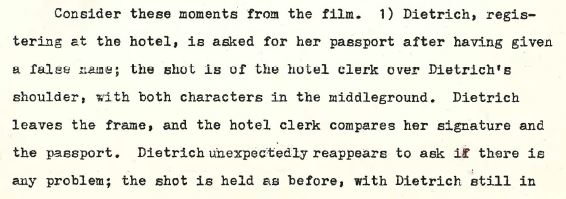
Lubitsch's Angel, 1978

I wrote this paper on Ernst Lubitsch's 1937 Angel when I was 22 years old, for a 1978 Steve Mamber class at UCLA. As usual with my early film writing, I'm embarrassed by the paper's youthful arrogance and excessive zeal for categorization. But the current Lubitsch retrospective at Film Forum prompted some friends to ask me for writing on Angel (one of my very favorite films), and I'll never have the chance to go into this much detail again. Below are scans of the original paper, with some of Steve's sensible criticisms still visible. I took the liberty of omitting a useless introductory paragraph.


Wednesday, February 8, 2017

James Bridges

In a comment on my last post, dm494 asked for a blurb on James Bridges' Mike's Murder that I wrote in 1984 for the Los Angeles Reader. I don't think much of the blurb, but here it is, along with a second blurb on Bridges' 1985 Perfect.


Thursday, January 26, 2017

2016 Manhattan One-Week-Run Premieres

Here are my favorite films that played at least one week in Manhattan for the first time in 2016, in approximate order of preference:
  1. L'avenir (Things to Come) (Mia Hansen-Løve, France)
  2. Manchester by the Sea (Kenneth Lonergan, USA)
  3. The Apostate (Federico Veiroj, Uruguay/Spain)
  4. Fireworks Wednesday (Asghar Farhadi, Iran)
  5. Trois souvenirs de ma jeunesse (My Golden Days) (Arnaud Desplechin, France)
  6. For the Plasma (Bingham Bryant and Kyle Molzan, USA)
  7. Francofonia (Aleksandr Sokurov, France)
  8. Mia Madre (Nanni Moretti, Italy)
  9. Short Stay (Ted Fendt, USA)
  10. A Hologram for the King (Tom Tykwer, USA/Germany)
  11. Right Now, Wrong Then (Hong Sang-soo, South Korea)
  12. The Fits (Anna Rose Holmer, USA)
  13. Fatima (Philippe Faucon, France)
Edward Yang's 1986 The Terrorizers received its first NYC theatrical run this year, and would be on this list if it felt anything like a 2016 film. (Fireworks Wednesday is ten years old, but it passes.)

Friday, December 16, 2016

Rabah Ameur-Zaïmeche and The Story of Judas


I was asked by programmer Delphine Selles-Alvarez to introduce FIAF's December 13 screening of the 2015 film Histoire de Judas (Story of Judas), the last film in a complete Rabah Ameur-Zaïmeche retrospective. There isn't much written on Ameur-Zaïmeche in English, and my notes for the introduction read well enough, so:

=====================================

I’d like to discuss some of the qualities of Ameur-Zaïmeche’s work so far, and talk a little about how tonight’s film grows out of what Ameur-Zaïmeche did before.

Some characteristics that we find in his work from the beginning:

1. An attention to documenting places and evoking their ambience, with emphasis on natural sound and a pleasure in long shots and long takes. He has a good compositional sense, with an eye for natural grandeur.

2. A tendency to suggest story rather than foreground it, giving a few muted story cues along with his evocations of locations: story emerges from within the ambience, or hides within it.

3. A tendency to present sympathetic and unsympathetic actions in a similar manner, and to let signals about characters be absorbed in the prevailing mood of the environments he creates.

The last three elements taken together make one think of Jean Renoir, in that both filmmakers want to document the world and in some sense they don’t want the fiction to triumph over the documentary - they want the fiction to be infused with the qualities of the documentation. As a side effect, both filmmakers evince a generosity toward people.

A few of Ameur-Zaïmeche’s characteristics come on stronger with his third and fourth films, Adhen and Les chants de Mandrin (Smugglers' Songs):

 1. A romanticism in the presentation of people and their struggles, and a pleasure in the heroic. The romanticism also has the general effect of making characters more admirable - Histoire de Judas is a good example.

2. A taste for abstraction in his stories and subjects: a suggestion of allegory or symbolism, a preference for stories that point to larger issues.  This tendency collides in an interesting way with the realism of image and sound that Ameur-Zaïmeche likes. The ambient style and the romantic largeness of the gestures and stories modify each other.  One can almost define Ameur-Zaïmeche’s style as the combination of these two tendencies.

Adhen used an unusual setting and striking art direction to create a sense of microcosm, of a part representing the whole. And after that Ameur-Zaïmeche left modern times and took up legendary subjects.  The socialist politics in his films come to the surface in this period, but the politics are expressed in romantic, heroic terms - I feel as if the romanticism is at least as important to him as his political aims.

On Histoire de Judas:

The solemnity of this particular story seems as if it might weigh the film down, but Ameur-Zaïmeche soon starts doing peculiar things with the material - the sanctified subject matter throws Ameur-Zaïmeche’s daring into relief. One small sign of his assertion is the modern way Jesus and Judas express their mutual affection: he humanizes them by transforming them into bros. I kind of like it because it’s so much him, even if it’s not the way I might approach the material: he’s using that male energy that we see in his other films.

I don’t want to give away the plot, but you’ll see big deviations from the New Testament version as the story goes along, changes that feel more artistically than politically motivated. One interesting addition that can perhaps be mentioned without spoiling the film is the important character of the madman who impersonates Jesus and functions in the film as his double, and who eventually is the focus of a emotional scene on the site of the crucifixion. Though such additions to the story are a bold gesture, they don’t alter the intent of the original much: Ameur-Zaïmeche seems to be trying to make vivid to himself the emotions of the story, rather than depart from it in fundamental ways.

In his last three films, Ameur-Zaïmeche has been moving a step at a time toward legend and grandeur: from the abstract conflict of Adhen to the Robin Hood-like figures of Les chants de Mandrin to the Christ story.  I’m curious where he goes from here, as his stories have pretty much gotten as big as they can get.

Monday, October 17, 2016

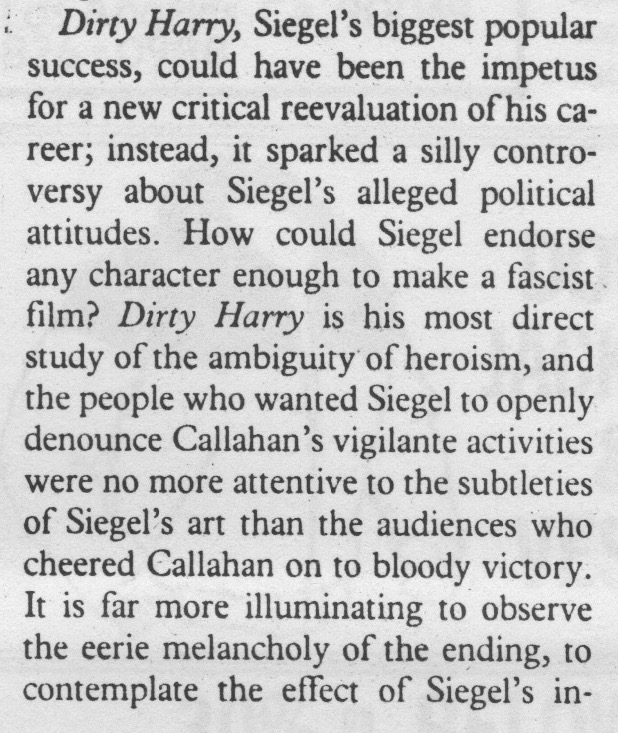
Don Siegel, 1980

I'm experimenting, none too successfully, with using Blogger to post .jpgs of print articles. This piece appeared in the L.A. Reader on October 24, 1980 on the occasion of a Don Siegel retrospective at USC. I am as always embarrassed by my never-in-doubt writing persona at age 25, and my assessment of the politics of Dirty Harry was plainly inadequate to the complexity of the issue; but a few of the ideas still seem worthwhile.