
 Posts
Posts


Thursday, March 27, 2008
La Femme Infidèle and Le Boucher
Kevin Lee invited me to discuss Chabrol's La Femme Infidèle and (the especially wonderful) Le Boucher with him recently, and he turned the discussion into three short (6 to 8-minute) video essays (here are videos one, two and three on YouTube) on his Shooting Down Pictures blog, where he does a great job of collecting both contemporary and modern commentary on the 1000 films in the canon according to They Shoot Pictures, Don't They?
Saturday, March 22, 2008
Jean Eustache's Circle: French Institute, April 1-29, 2008
The French Institute, they of the horribly wrinkled screen, has sprung an impressive little retrospective on us with very little notice. Tuesdays in April will be devoted to Jean Eustache's Circle, with films by Eustache and other culturally related filmmakers. Most readers will probably be familiar with Eustache's devastating La Maman et la Putain (April 29 at 12:30 and 7 pm), which is not so rare these days that you have to watch it on that funhouse screen. But all five of the Eustache programs are excellent, though no two of them resemble each other enough for you to be able to predict what's coming next. I'm hoping that the French Institute's website is right about the documentary Le Cochon (April 22 at 4 and 9 pm) having English subtitles, as I don't believe it's ever screened here with translation - I have a feeling that we're going to get the unsubbed print, though. The non-Eustache selections are just as noteworthy: the best is probably Pialat's great L'enfance nue (April 15 at 12:30 and 7 pm), but the scarcest is Jacques Rozier's obscure Du côté d’Orouët (April 1 at 12:30 pm only).
Friday, March 21, 2008
Comments Vanishing
One of this blog's readers says that he posted two comments recently that disappeared quickly. Has this happened to anyone else? If so, drop me a line at sallitt at post dot harvard dot edu.
Tuesday, March 18, 2008
Les Yeux sans visage: Anthology Film Archives, Wednesday, March 19, 2008
I wrote a short piece on Georges Franju's Les Yeux sans visage for the Auteurs' Notebook. (The piece contains serious spoilers.) Les Yeux screens once more at Anthology Film Archives on Wednesday, March 19 at 7 pm.
Monday, March 17, 2008
Rendez-Vous with French Cinema Wrap-Up
Vadim Rizov asked me for a wrap-up of Lincoln Center and IFC's Rendez-Vous with French Cinema series. I saw five films at Rendez-Vous, and had already seen one of the titles at Toronto. In approximate order of preference:
Tout est pardonné (All is Forgiven): I really like this one. The attention to ambient realism, and the chunky storytelling, reminded me a bit of Pialat, as did Hansen-Løve's willingness to let the characters contradict themselves emotionally from one scene to the next. (Pialat never would have chosen to tell a heartfelt story like this, though.) The film really kicks in in its second half, with the introduction of Constance Rousseau, who is the most expressive non-professional actor, like, ever. I loved the way Hansen-Løve declines to "narrate" the progression of the girl's feelings for her long-absent father: her plausible and understated emotions simply succeed each other across the time jumps.
Les Chansons d'amour (Love Songs): A weird movie that seems to be the expression of a genuinely weird personality. A big part of Honoré is old-fashioned surrealist, devoted to disconcerting and affronting us by various means, not the least of which is the use of the musical form in an unthinkable emotional context. And then, as if he has pushed hard enough to satisfy himself, he moves from acting out and goofiness into a solemn sincerity, and scores a number of emotionally complex coups. I kind of wish I could write the guy off, but I can't.
La Question humaine (Heartbeat Detector): A perplexing movie. I disliked it most of the way, but eventually acquired a grudging and partial respect for it. Klotz's odd distance from the fiction reminded me of Oliveira at times. When the Holocaust material is introduced in the second half, the film becomes almost too thematically tight, using the issue of the dangers of euphemistic technical language to put all its targets in one basket. The characters remain concepts and even mouthpieces, but Klotz's cold style becomes more impressive as it manages to stitch together the increasingly multifarious narrative.
Ceux qui restent (Those Who Remain): a character-based story with a few subtleties of conception but a rather heavy hand in the execution department. Both Lindon and Devos do a nice job with characters who are straitjacketed by their functions in the script. The story refuses to resolve in the expected way, failing to redeem the character who was earmarked for redemption. Not really a bad film, but not exciting enough either, suspended somewhere between the arty and the commercial.
Paris: I'm getting a little worn down by Klapisch. The film's brisk scene switches among the ensemble are interesting for a while, but practically every vignette is turned to some showy, exhibitionistic purpose. None of the characters really got their due, though there were lots of good performances, especially Binoche's.
Un baiser s'il vous plaît (Shall We Kiss?): rough sledding for me. It reminded me of a variety skit played at half-speed: characters are stripped down until they serve only the barest comic functions, discomfort and awkwardness are dragged out as long as possible. The concept of love on display here is so fantastically simplified that only a naif or a nihilist could be satisfied with it.
Tout est pardonné (All is Forgiven): I really like this one. The attention to ambient realism, and the chunky storytelling, reminded me a bit of Pialat, as did Hansen-Løve's willingness to let the characters contradict themselves emotionally from one scene to the next. (Pialat never would have chosen to tell a heartfelt story like this, though.) The film really kicks in in its second half, with the introduction of Constance Rousseau, who is the most expressive non-professional actor, like, ever. I loved the way Hansen-Løve declines to "narrate" the progression of the girl's feelings for her long-absent father: her plausible and understated emotions simply succeed each other across the time jumps.
Les Chansons d'amour (Love Songs): A weird movie that seems to be the expression of a genuinely weird personality. A big part of Honoré is old-fashioned surrealist, devoted to disconcerting and affronting us by various means, not the least of which is the use of the musical form in an unthinkable emotional context. And then, as if he has pushed hard enough to satisfy himself, he moves from acting out and goofiness into a solemn sincerity, and scores a number of emotionally complex coups. I kind of wish I could write the guy off, but I can't.
La Question humaine (Heartbeat Detector): A perplexing movie. I disliked it most of the way, but eventually acquired a grudging and partial respect for it. Klotz's odd distance from the fiction reminded me of Oliveira at times. When the Holocaust material is introduced in the second half, the film becomes almost too thematically tight, using the issue of the dangers of euphemistic technical language to put all its targets in one basket. The characters remain concepts and even mouthpieces, but Klotz's cold style becomes more impressive as it manages to stitch together the increasingly multifarious narrative.
Ceux qui restent (Those Who Remain): a character-based story with a few subtleties of conception but a rather heavy hand in the execution department. Both Lindon and Devos do a nice job with characters who are straitjacketed by their functions in the script. The story refuses to resolve in the expected way, failing to redeem the character who was earmarked for redemption. Not really a bad film, but not exciting enough either, suspended somewhere between the arty and the commercial.
Paris: I'm getting a little worn down by Klapisch. The film's brisk scene switches among the ensemble are interesting for a while, but practically every vignette is turned to some showy, exhibitionistic purpose. None of the characters really got their due, though there were lots of good performances, especially Binoche's.
Un baiser s'il vous plaît (Shall We Kiss?): rough sledding for me. It reminded me of a variety skit played at half-speed: characters are stripped down until they serve only the barest comic functions, discomfort and awkwardness are dragged out as long as possible. The concept of love on display here is so fantastically simplified that only a naif or a nihilist could be satisfied with it.
Wednesday, March 12, 2008
The Tracey Fragments: MOMA, March 14 and 18, 2008
Bruce McDonald's amazing The Tracey Fragments, which is slated for U. S. distribution by ThinkFilm on May 9, is screening at MOMA (on Friday at 6:15 pm and Tuesday at 7:30 pm) as part of its Canadian Front series. Here's what I wrote about the film for my Toronto 2007 wrapup at Senses of Cinema:
"Meanwhile, in Berlin’s Panorama section, Canadian director Bruce McDonald reinvented the cinema with his remarkable The Tracey Fragments, adapted by Maureen Medved from her stream-of-consciousness novel about a 15-year-old Winnipeg girl (Ellen Page) suffering dramatically from the slings and arrows of adolescence. McDonald undertakes to break the screen into an array of panels, of ever-changing quantity and attributes, each containing an independent image. Whether McDonald has created an entirely new art form or an N-dimensional version of an old one, it’s immediately clear that every law of the cinema is rewritten in this universe, and that even the most arid and academic forms of montage are transformed into infinitely flexible instruments. Knowing that he’s discovered the philosopher’s stone, McDonald tirelessly generates new formal prototypes every few seconds, and leaves us at film’s end with the sense that he could have kept going forever. What makes Tracey more than an impressive demo is its unity of form and feeling, the sense that its screen may have been shattered by its young protagonist’s hormonal violence, McDonald’s wild-eyed punkish sense of drama, and Medved’s vivid dialogue (“He touched me, he stuck his cock in me, and he said I love you, in that – exact – order!”). Old-school viewers may have a tough time adjusting to Tracey’s fragmentation, but even they might appreciate McDonald’s surprising compositional grace, which culminates in a beautiful, melancholy riverside tracking shot under the end credits."
I wouldn't be surprised if it were difficult to get into the MOMA screenings, given Page's well-deserved popularity in the wake of Juno. I hope to blog more extensively about Tracey soon.
"Meanwhile, in Berlin’s Panorama section, Canadian director Bruce McDonald reinvented the cinema with his remarkable The Tracey Fragments, adapted by Maureen Medved from her stream-of-consciousness novel about a 15-year-old Winnipeg girl (Ellen Page) suffering dramatically from the slings and arrows of adolescence. McDonald undertakes to break the screen into an array of panels, of ever-changing quantity and attributes, each containing an independent image. Whether McDonald has created an entirely new art form or an N-dimensional version of an old one, it’s immediately clear that every law of the cinema is rewritten in this universe, and that even the most arid and academic forms of montage are transformed into infinitely flexible instruments. Knowing that he’s discovered the philosopher’s stone, McDonald tirelessly generates new formal prototypes every few seconds, and leaves us at film’s end with the sense that he could have kept going forever. What makes Tracey more than an impressive demo is its unity of form and feeling, the sense that its screen may have been shattered by its young protagonist’s hormonal violence, McDonald’s wild-eyed punkish sense of drama, and Medved’s vivid dialogue (“He touched me, he stuck his cock in me, and he said I love you, in that – exact – order!”). Old-school viewers may have a tough time adjusting to Tracey’s fragmentation, but even they might appreciate McDonald’s surprising compositional grace, which culminates in a beautiful, melancholy riverside tracking shot under the end credits."
I wouldn't be surprised if it were difficult to get into the MOMA screenings, given Page's well-deserved popularity in the wake of Juno. I hope to blog more extensively about Tracey soon.
Georges Franju: Anthology Film Archives, March 14-20, 2008
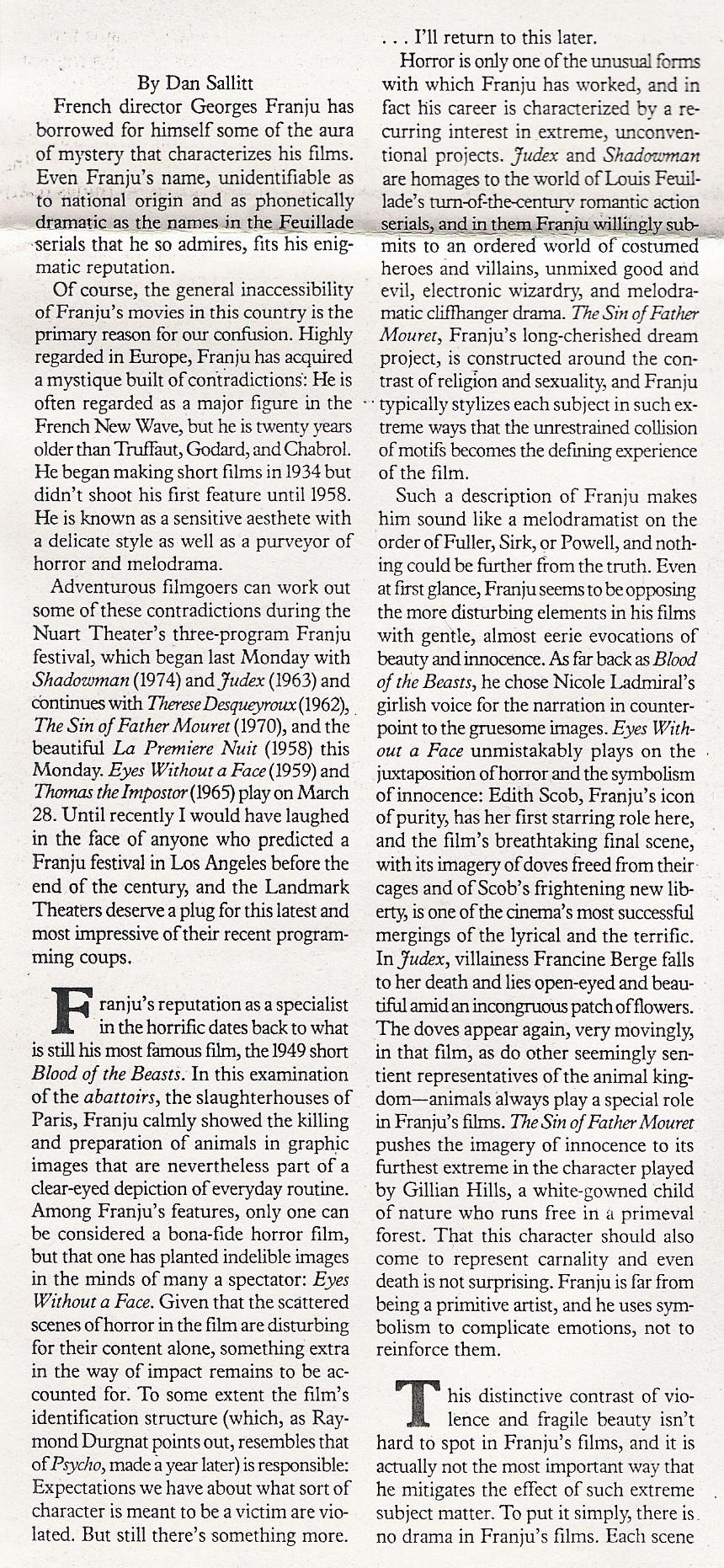
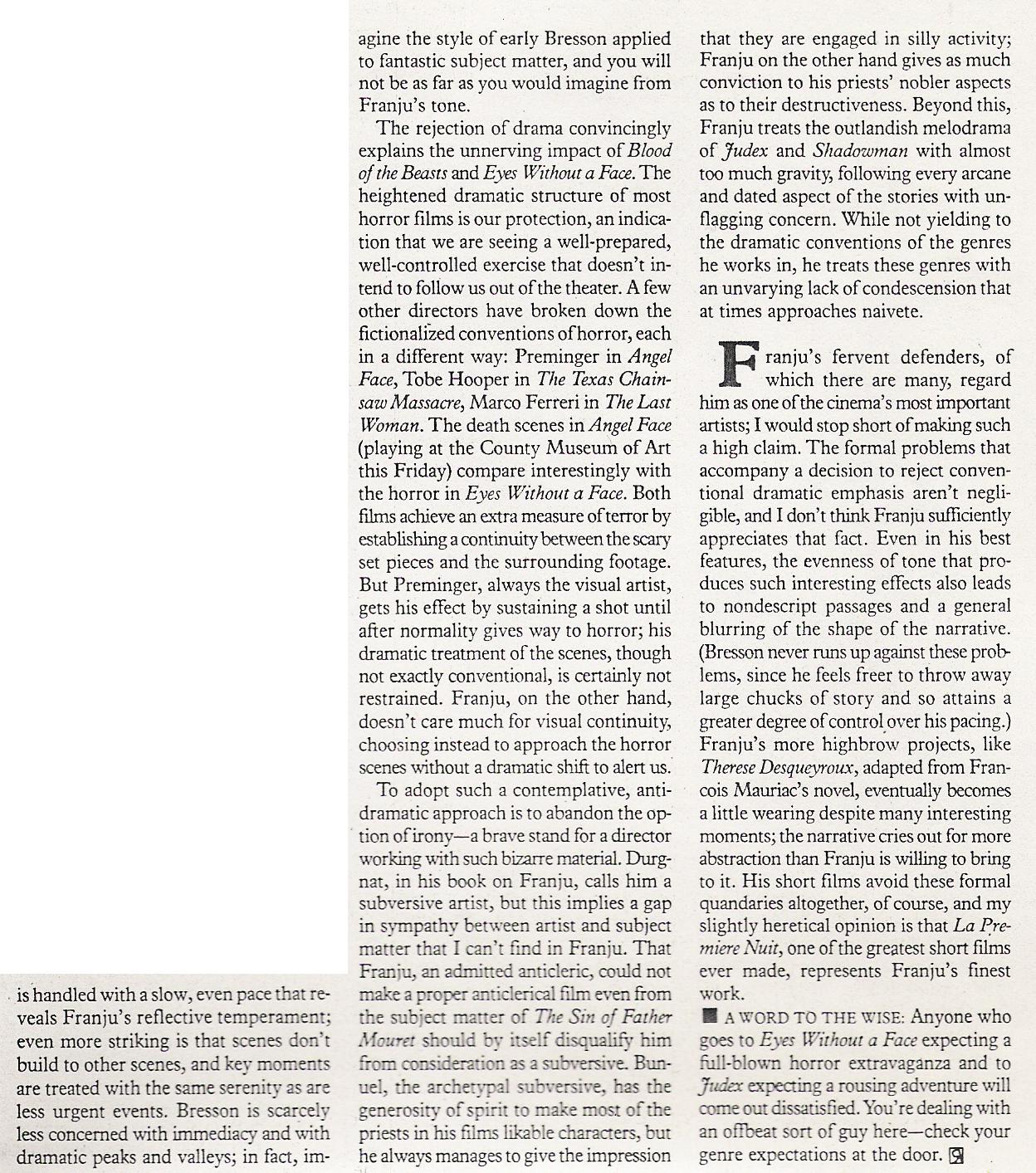
Starting this Friday, Anthology Film Archives will devote a week to French director Georges Franju, screening four of his features and a program of short works. Here's a scan of an L. A. Reader article (pages one and two) that I wrote on the occasion of a similar Franju retrospective in 1983.
Subscribe to:
Posts (Atom)