
 Posts


Tuesday, March 18, 2008
Les Yeux sans visage: Anthology Film Archives, Wednesday, March 19, 2008
I wrote a short piece on Georges Franju's Les Yeux sans visage for the Auteurs' Notebook. (The piece contains serious spoilers.) Les Yeux screens once more at Anthology Film Archives on Wednesday, March 19 at 7 pm.
Monday, March 17, 2008
Rendez-Vous with French Cinema Wrap-Up
Vadim Rizov asked me for a wrap-up of Lincoln Center and IFC's Rendez-Vous with French Cinema series. I saw five films at Rendez-Vous, and had already seen one of the titles at Toronto. In approximate order of preference:
Tout est pardonné (All is Forgiven): I really like this one. The attention to ambient realism, and the chunky storytelling, reminded me a bit of Pialat, as did Hansen-Løve's willingness to let the characters contradict themselves emotionally from one scene to the next. (Pialat never would have chosen to tell a heartfelt story like this, though.) The film really kicks in in its second half, with the introduction of Constance Rousseau, who is the most expressive non-professional actor, like, ever. I loved the way Hansen-Løve declines to "narrate" the progression of the girl's feelings for her long-absent father: her plausible and understated emotions simply succeed each other across the time jumps.
Les Chansons d'amour (Love Songs): A weird movie that seems to be the expression of a genuinely weird personality. A big part of Honoré is old-fashioned surrealist, devoted to disconcerting and affronting us by various means, not the least of which is the use of the musical form in an unthinkable emotional context. And then, as if he has pushed hard enough to satisfy himself, he moves from acting out and goofiness into a solemn sincerity, and scores a number of emotionally complex coups. I kind of wish I could write the guy off, but I can't.
La Question humaine (Heartbeat Detector): A perplexing movie. I disliked it most of the way, but eventually acquired a grudging and partial respect for it. Klotz's odd distance from the fiction reminded me of Oliveira at times. When the Holocaust material is introduced in the second half, the film becomes almost too thematically tight, using the issue of the dangers of euphemistic technical language to put all its targets in one basket. The characters remain concepts and even mouthpieces, but Klotz's cold style becomes more impressive as it manages to stitch together the increasingly multifarious narrative.
Ceux qui restent (Those Who Remain): a character-based story with a few subtleties of conception but a rather heavy hand in the execution department. Both Lindon and Devos do a nice job with characters who are straitjacketed by their functions in the script. The story refuses to resolve in the expected way, failing to redeem the character who was earmarked for redemption. Not really a bad film, but not exciting enough either, suspended somewhere between the arty and the commercial.
Paris: I'm getting a little worn down by Klapisch. The film's brisk scene switches among the ensemble are interesting for a while, but practically every vignette is turned to some showy, exhibitionistic purpose. None of the characters really got their due, though there were lots of good performances, especially Binoche's.
Un baiser s'il vous plaît (Shall We Kiss?): rough sledding for me. It reminded me of a variety skit played at half-speed: characters are stripped down until they serve only the barest comic functions, discomfort and awkwardness are dragged out as long as possible. The concept of love on display here is so fantastically simplified that only a naif or a nihilist could be satisfied with it.
Wednesday, March 12, 2008
The Tracey Fragments: MOMA, March 14 and 18, 2008
Bruce McDonald's amazing The Tracey Fragments, which is slated for U. S. distribution by ThinkFilm on May 9, is screening at MOMA (on Friday at 6:15 pm and Tuesday at 7:30 pm) as part of its Canadian Front series. Here's what I wrote about the film for my Toronto 2007 wrapup at Senses of Cinema:
"Meanwhile, in Berlin’s Panorama section, Canadian director Bruce McDonald reinvented the cinema with his remarkable The Tracey Fragments, adapted by Maureen Medved from her stream-of-consciousness novel about a 15-year-old Winnipeg girl (Ellen Page) suffering dramatically from the slings and arrows of adolescence. McDonald undertakes to break the screen into an array of panels, of ever-changing quantity and attributes, each containing an independent image. Whether McDonald has created an entirely new art form or an N-dimensional version of an old one, it’s immediately clear that every law of the cinema is rewritten in this universe, and that even the most arid and academic forms of montage are transformed into infinitely flexible instruments. Knowing that he’s discovered the philosopher’s stone, McDonald tirelessly generates new formal prototypes every few seconds, and leaves us at film’s end with the sense that he could have kept going forever. What makes Tracey more than an impressive demo is its unity of form and feeling, the sense that its screen may have been shattered by its young protagonist’s hormonal violence, McDonald’s wild-eyed punkish sense of drama, and Medved’s vivid dialogue (“He touched me, he stuck his cock in me, and he said I love you, in that – exact – order!”). Old-school viewers may have a tough time adjusting to Tracey’s fragmentation, but even they might appreciate McDonald’s surprising compositional grace, which culminates in a beautiful, melancholy riverside tracking shot under the end credits."
I wouldn't be surprised if it were difficult to get into the MOMA screenings, given Page's well-deserved popularity in the wake of Juno. I hope to blog more extensively about Tracey soon.
Georges Franju: Anthology Film Archives, March 14-20, 2008
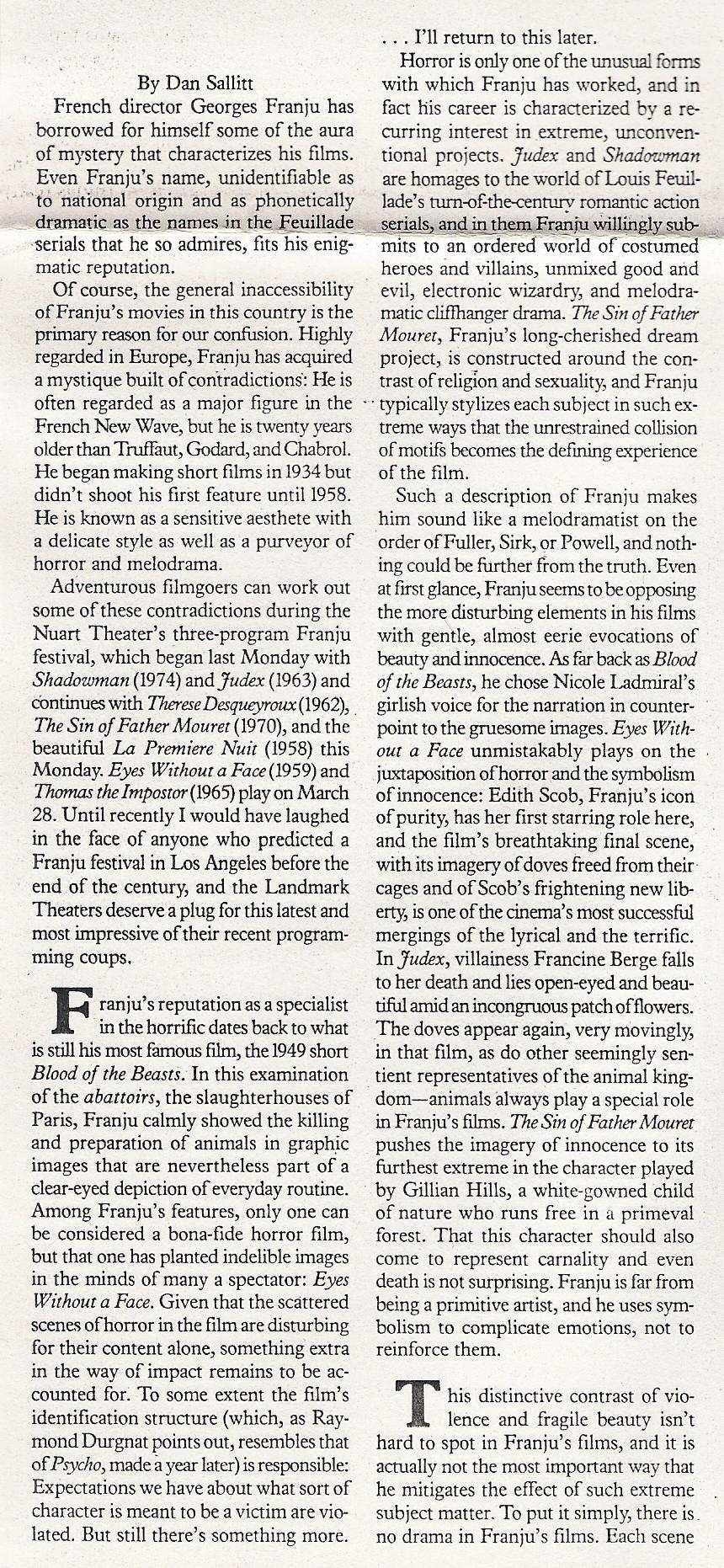
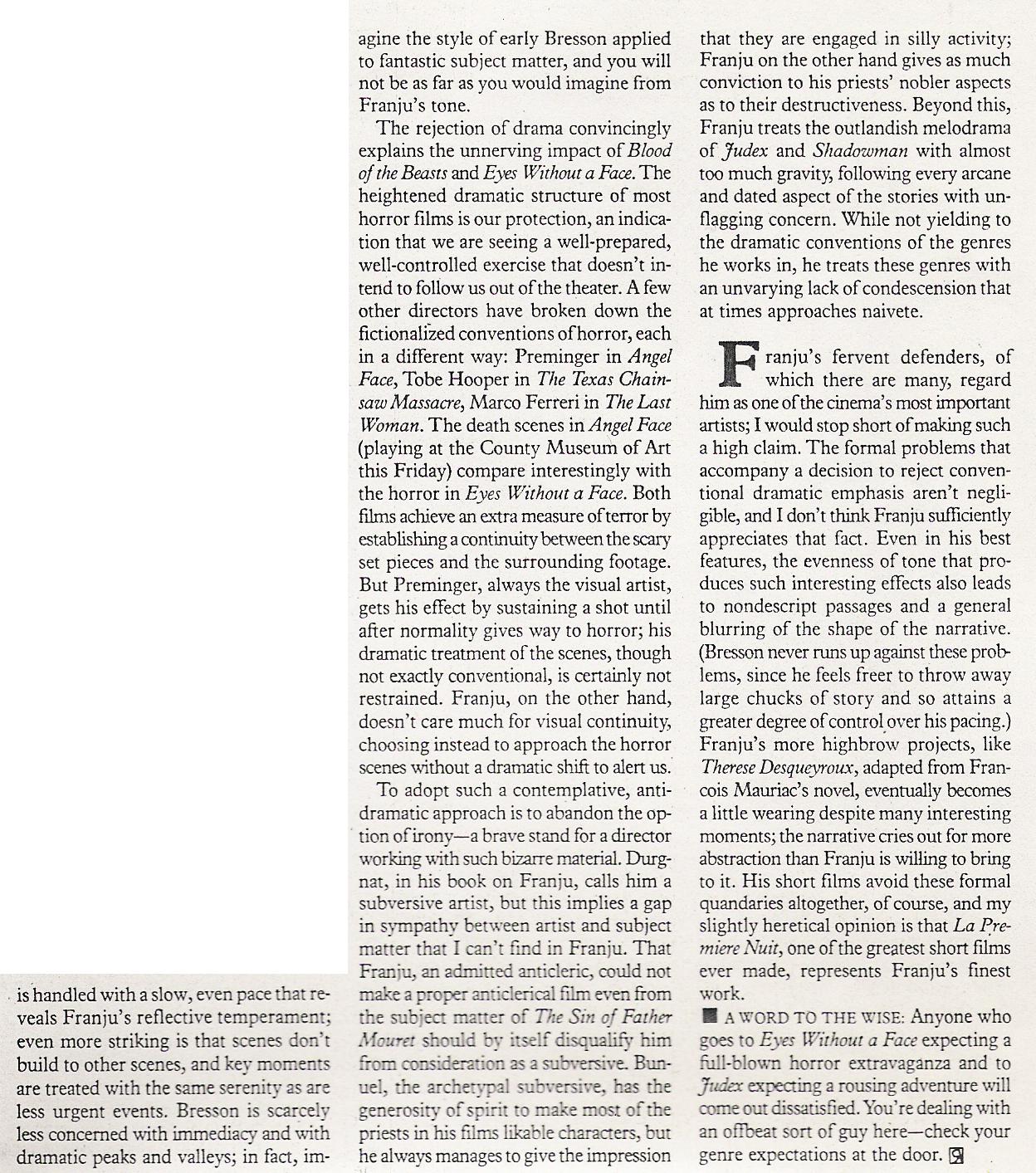
Starting this Friday, Anthology Film Archives will devote a week to French director Georges Franju, screening four of his features and a program of short works. Here's a scan of an L. A. Reader article (pages one and two) that I wrote on the occasion of a similar Franju retrospective in 1983.
Monday, March 10, 2008
It Always Rains on Sunday: Film Forum, through March 13, 2008
British director Robert Hamer is known here primarily for Kind Hearts and Coronets and the mirror episode of Dead of Night. He has only a few other major films to his credit, all clustered in the five years after World War II. Yet those few films are enough to mark him as a master. 1947's It Always Rains on Sunday is an unusual outing for Hamer, dense in social observation, crowded with urban debris that partly conceals his wonderful eye for stark, contained compositions. Hamer and his co-writers (Henry Cornelius and Angus MacPhail, adapting a novel by Arthur La Bern) set out to recreate the sociology of post-war London's East End, with the underworld shading imperceptibly into the put-upon working poor, women struggling with the slow-dawning prospect of economic independence, the Jewish community struggling in various ways for a foothold. Remarkably, the personal story in the foreground - a hard, pragmatic step-mother (Googie Withers) risks her family and security to shelter an escaped convict and ex-lover (John McCallum) - grows organically out of the film's sociological concerns, illuminating rather than distracting from them. Hamer is as confident in his regulation of a broad range of human activity as he is with static, lucid imagery: the solemnity and stoicism of his world view brings a quiet dignity, almost a heroism, to the humblest subject matter. It Always Rains on Sunday plays for a few more days at Film Forum.
Tuesday, March 4, 2008
Michel Deville, Nina Companéez, and À cause, à cause d'une femme
I'm thinking again about French director Michel Deville: why he remains so underrated after 50 years of filmmaking, why his films are so difficult to see. The occasion for these musings is my first viewing of Deville's wonderful 1963 À cause, à cause d'une femme, which as far as I know has no critical reputation and is not available in any medium. (A friend taped it for me off Cyprus TV, without subtitles.)
Deville has made about 30 films, 15 of which I've managed to see over the years. After a little-known, co-directed 1958 debut called Une balle dans le canon, he formed a close collaboration with writer/editor Nina Companéez, with whom he made a dozen or so films between 1961 and 1971. Both the writing and the editing of these films is so distinctive that it is reasonable to wonder how much of their magic Companéez took with her when the collaboration ended. She went on to direct a few features, one of which, 1972's Faustine et le bel été, has admirers. After that she worked mostly in French TV; other than a co-writing credit on Rappeneau's 1995 Le Hussard sur le toit, I don't believe she's had much recent international exposure.
At times it seemed that Deville may have lost artistic focus in his post-Companéez period. But his filmography doesn't support a theory of simple decline. Not only has he made a number of extraordinary post-Companéez films (especially 1988's brilliant La Lectrice), but the writing and editing of the later films often partake of the same sensibility that we find in the Companéez collaborations. Not enough of Deville's and Companéez's careers are available in the United States for me to make clear distinctions between their artistic personalities. It's especially regrettable that international distribution of Deville's work has fallen off since 1990.
Not that Deville's early films made too big a splash abroad. Benjamin (1968) seems to have traveled the most, but it is never revived. The first two Deville-Companéez films, Ce soir ou jamais (1961) and Adorable menteuse (1962), garnered a few admirers in English-speaking countries: the latter, especially, is a brilliant example of the kind of subject matter and tone that the filmmakers cultivated over the years.
À cause, à cause d'une femme, which immediately followed these first two efforts, is even more obscure, and yet no less dazzling. Its story is the airiest entertainment imaginable: a carefree Don Juan (Jacques Charrier) is falsely accused of murder by a jealous lover (Juliette Mayniel), and tries to clear his name, with the help of a few loyal girlfriends, while on the run from the police.
This kind of lightweight material is common for Deville-Companéez. They skip and jump through the story with deft transitions that create a reflexive, playful distance. One of their favorite devices is the whip-pan that picks up the action of the next scene; in general, any cue that moves the story forward results in a graceful ellipsis that favors momentum over scene establishment. There's a very funny moment where one of the hero's girlfriend/helpers (Mylène Demongeot) tells a tall tale to a hotel clerk to gain entry: Deville holds the shot on the girl as she gives her long, daffy spiel, then cuts abruptly to the clerk as he yields the room number, giving him barely enough time to register on our retinas before ending the scene. Throughout his career, Deville plays with this sort of comically ragged editing, which draws attention to the artifice of the storytelling even as it returns control immediately to the narrative.
(This entry really needs visual aids, but I don't have a digital copy of the movie. If anyone does, and gets it to me, I'll edit clips in.)
Deville and Companéez are interested, not in the mechanics of their commonplace plots, but in an affectionate and profuse evocation of the feminine principle, and in giving a deadly serious account of romantic love. To promote these interests, the network of lovers who both persecute and sustain the hero do most of the work of moving the story forward, in an endless Parisian warren of white, mirrored bedrooms and parlors that seem to interconnect. (A classic Deville-Companéez touch: Demongeot tries repeatedly to shake a cop on her tail. Giving up, she stops at an outdoor stall to try on a few hats. The cop is confused by the fashion moment, and Demongeot is surprised to find herself in the clear.) And the female-supported hero finds himself on a mission far more important than escaping his murder frameup when he falls hopelessly, solemnly in love with the one woman (Jill Haworth) who does not return his affection.
To give full play to their concerns while remaining faithful to their narrative task, Deville and Companéez direct us to the important stuff largely through cinematic form. One of Deville's pet formal ploys is to move dramatically in for sets of cross-cut closeups that focus us on emotions that do not pertain directly to the story. Like the abrupt cutting during transitions, the change from long shot to closeup is so much larger than expected that it becomes a form of direct address, tipping us off to the filmmakers' concerns.
Even more strikingly, Deville and Companéez overload their transitions with poetry. It's not a big exaggeration to say that they do most of their important work during transitions: the practical apparatus of getting from one scene to another is hijacked by the filmmakers and transformed into moments of great lyrical or symbolic power. When one girlfriend (Marie Laforêt) creates a distraction to allow the hero to pass to the room of another (Demongeot), Deville-Companéez make the scene transition on a beautiful, unexpected motion cut that fuses the images of the two girlfriends whirling to face us. Later in the film, the hero and his hopelessly unavailable love object have been drenched in a storm; the filmmakers transition on two sensuous, rhyming shots of them each drying their hair in their own bathrooms.
All Deville and Companéez's films use allusions to classical art as a springboard to greater emotional intensity. From the pre-credit sequence, in which the hero and his vengeful lover move through a pastoral setting; through the farce conventions of hotel rooms exchanged and traversed; to the climax of the love story, set in a room improbably adorned with a loom, medieval-style tapestries, and a standing candlestick: the filmmakers deploy imagery and music to recast the mundane present-day story in mythological terms. The film's most beautiful moments have the aura of fable: a rapturous flashback that the filmmakers refuse to end after it serves its narrative purpose; a fireside shot in which the hero's beloved is gathered by her lover as the hero kneels in the foreground, ignored as if he were invisible.
Sorry to go on about a movie that you probably can't see. In hopes of sparking your interest, here's a complete list of the Deville-Companéez collaborations: as far as I know, not a single one is available on DVD with English subtitles. (Beware the dubbed black-and-white DVD of L'Ours et la poupée that Fox Lorber tried to palm off as The Bear and the Doll. Benjamin also circulates in a dubbed DVD - the one I bought from Super Happy Fun is of unwatchably low quality.) The four that I've seen are all better than good.
- Ce soir ou jamais (1961)
- Adorable menteuse (1962)
- À cause, à cause d'une femme (1963)
- Lucky Jo (1964)
- L'Appartement des filles (1964)
- Les Petites demoiselles (1964) - made for TV
- On a volé la Joconde (1966)
- Martin Soldat (1966)
- Zärtliche Haie (1967) - made in West Germany
- Bye bye, Barbara (1968)
- Benjamin (1968)
- L'Ours et la poupée (1969)
- Raphaël ou le débauché (1971)
Thursday, February 28, 2008
His Girl Friday
I have a long-standing pet theory about Hawks' comedies that I'm starting to question. The theory is that the comedies contain two different kinds of characters, pitched at different levels of abstraction: one more plausible and naturalistic, the other more stylized and exaggerated. And that the films document the perplexity of the more naturalistic characters as they are confronted by refugees from a different and wilder movie.
One reason the theory is appealing is that Hawks' dramas clearly depend for their effect on the manipulation of multiple levels of realism. Hawks creates genre-based expectations using story, decor, secondary characters, etc., and then encourages the lead actors to play the movie faster, smaller, more casually than the setup leads us to expect.
I recently revisited His Girl Friday, no doubt the greatest Hawks comedy, for the first time in decades. (I watched it eleven times between 1973 and 1985, then gave it a long rest.) His Girl Friday and Bringing Up Baby (which I saw not too long ago) are the comedies that best support my old theory. But now I'm not so sure that the concept holds up.
Obviously Hildy Johnson would be the more scaled-down, psychologically readable character in my schema, and Walter Burns would be the creature from the House of Fiction. But, even in the first big duel between Walter and Hildy in Walter's office, one notices a great deal of choreography: stylized, balletic moves that seem designed to show off artifice. Hildy slips out of Walter's grasp with split-second timing; Walter knows when Hildy will throw that pillow at him, and at what angle. Surely there's a sense in which Hildy and Walter inhabit the same plane of abstraction, not different planes. Both actors play-act openly; and our pleasure comes from watching and sharing their delight in having pulled it off, or sometimes their amusement at not quite pulling it off.
Bruce Baldwin, Hildy's suitor, is really only slightly more plausible a lover than the absurd Miss Swallow in Bringing Up Baby. If we divide the film into opposing aesthetic principles, one more realist and one more fantastic, then Bruce has to follow Hildy into the more realist sector, and we must then account for her bizarre desire to settle down with this "paragon," who no less than Walter beckons Hildy into the realm of burlesque.
Instead of trying to justify such a bifurcation, it makes more sense to me now to view Hawks' comedies more in the way that I view his dramas. In other words, less in terms of one set of actors opposed to another, and more in terms of the actors working and playing together, opening up a gap between themselves and their genre-identified environment, and amusing themselves by acknowledging that gap.
Still, somehow there is a difference between the comedies and the dramas: all Hawks commentators have puzzled over it. It occurs to me that most adventure-based genres don't interfere very much with Hawks' desire to create the kind of idealized characters he enjoys. He evokes genre mostly with background elements and introductory passages; his actors perform their genre duties while both having fun and projecting Hawks' idea of what he'd like people to be. Whereas comedy, at least to the extent that it comes with genre coding, seems to require that actors behave in an eccentric or outrageous manner. This is a potential issue, because Hawks likes his characters to embody his ideals.
In my post on Bringing Up Baby, I talked about how the film seems to be split in two by these impulses: the need to create clear genre signals with goofy characters; and the desire to enjoy the company of ideal characters. I believe that this tension is what gave rise in my mind to the idea that Hawks' comedies are built around the formal conceit of the collision of characters from different kinds of movies.
Judging from interviews, His Girl Friday seems to have been a conscious effort on Hawks' part to tone down the unreality of the comic hijinks in Baby. The tensions within the earlier film have been reduced, or at least made less conspicuous. Modern audiences can admire and emphathize with Hildy Johnson in a way that they cannot with David Huxley.
There's a quietly stunning moment in His Girl Friday where Hawks shoots the works on two brief closeups of Hildy, eating lunch with Bruce and getting off a few wisecracks at Walter's expense: "He comes by it naturally - his grandfather was a snake." The background of the restaurant is suddenly dense: dark shadows overhead, bit players in motion, cigarette smoke. Hildy is eating her food, enjoying the ambience. The shots would work perfectly in a Hawks drama - in fact they look a bit like Only Angels Have Wings, the other Hawks film shot by Joseph Walker - and take their place with the many other idyllic interludes in bars and cafes in Hawks's work, evoking the pleasures of social intercourse. Bringing Up Baby couldn't have accommodated such images - it isn't drama-friendly enough.
But the comedy-vs.-drama tensions of the earlier film haven't been eliminated altogether. Hawks and his writers (credited Charles Lederer, uncredited Ben Hecht and Morrie Ryskind, maybe others) devised a two-part structure in an attempt to balance the film's comic and dramatic needs. In the first section of the film, Hildy is firm in her desire to leave the newspaper business behind, and the film slowly sets up the pleasure-giving mechanism of the Earl Williams case. There is lots of fast dialogue and good comic business in these early scenes, but there are also daringly slow, pregnant passages: not only the celebrated scene where Hildy interviews Earl (precisely pitched between cynicism and empathy, readable either way), but also the remarkable, very long dead spot after the reporters torment Molly Malone, with bad conscience killing dialogue, leaving only the sparse ambience of the news room to fill the movie until Hildy's return.
The first section ends with the Earl Williams prison break and Hildy's instinctive reenlistment as an investigative reporter. This scene, invested with considerable weight by Hawks' framing and decoupage (Hawks holds a medium shot of Hildy as the news room goes wild, then tracks behind her as she casts her lot with the newspaper life), takes much of the suspense out of Hildy's dramatic arc. She will continue to resist her fate after this, but the filmmakers won't take her nearly as seriously. The second section of the film is a comic elaboration of the consequences of Hildy's backslide, and a mere coda from the point of view of dramatic development. Walter Burns, who has heretofore lurked in the film's margins, seizes center stage, now that the preeminence of his world view has been established; and Hildy begins to function as little more than one of his imps. As if to confirm the ascendency of the Walter principle, the second half is punctuated with as many affronts to decency as Hawks and the writers can fit in. The ending, with Hildy once again disappointed and humiliated, is probably best understood in terms of this current of nihilistic comedy: the tour that Hildy has signed up for is a lot of fun (in fact, it's where all the fun in the film is), but she cannot expect justice and dignity there.
It's an odd place for a Hawks hero to wind up, and there are moments along the way where the ego-negating farce isn't a perfect fit for the level-headed gal who sat in that dreamy restaurant. The question is not so much whether she would fall for the devil again, but whether she would keep the plot spinning by putting up token resistance after her fall.
Does this difficulty in reconciling characterization with the principles of farce constitute an imperfection? It feels that way at times. Do I wish the imperfection were eliminated? I don't think so. Without the introduction of farce, Hawks wouldn't have a logical path that he can follow to the point of chaos. Maybe the spots where the two aesthetic planes don't quite meet are the price we pay for the excitement generated by bringing them together.
David Bordwell recently posted an interesting account of His Girl Friday's critical standing over the decades.
Subscribe to:
Posts (Atom)